Pay‑As‑You‑Go Demo: The Private Gallery in Web3
After weeks of diving into article registries and rental modules, I finally reached the stage every developer craves: making it all visible. It’s one thing to see 0x... addresses in a terminal; it’s another to see a “Private Gallery” package actually work on a UI.
The Journey So Far
This post is the grand finale of my series on building a Pay-As-You-Go (PAYG) ecosystem. If you’re joining just now, here’s how we got here:
-
Transitioning to Web3: My initial shift from traditional development to Solidity.
-
Article Registries: Building the foundation for on-chain content services.
-
Rental Services: Extending the protocol to handle time-based infrastructure.
-
The Composition Layer: Creating the Pool Protocol to bundle multiple services together.
Today, I’m excited to share a live demo that ties everything together. I chose a Private Gallery as the use case because it perfectly illustrates the messiness of real-world collaboration: you have content (art), a venue (hotel), and security. Normally, that’s three separate contracts and a lot of trust. With the Pool Protocol, it’s just one transaction.
The Problem We’ve All Faced
We’ve all been there: trying to bundle different services but ending up with a nightmare of multiple invoices and manual splits. In Web3, we can do better than just “sending tokens”; we can program the revenue logic directly into the purchase.
I wanted to show that on-chain composition isn’t just about technical feasibility—it’s about solving real coordination problems. When I started building this demo, I kept asking myself: “What if a user wants to buy access to multiple services from different providers, but pay once? What if those providers need to split revenue automatically?”
The answer became Pool #42: a Private Gallery Access package that bundles an art collection, a hotel space, and security services. One payment. Three providers. Automatic settlement.
Connecting the Dots: How a Gallery Becomes a Pool
When I was designing this, I kept picturing that high-end gala scene from Mission: Impossible — Fallout at the Grand Palais. What if we could bring that kind of complex setup directly on-chain?
For me, this framework isn’t just a technical showcase. The real challenge is: can we translate all those messy coordination and trust costs from the physical world into decentralized services? Whether it’s an individual or a premium client, they shouldn’t have to deal with three suppliers, sign three contracts, and make three separate payments. Through this Pool, content, venue, and security get bundled into one simple PAYG product. At its core, it’s about bringing Web3 back to basics: one purchase, automatic settlement, instant delivery.
On-chain, this maps to services from different registries. The art collection lives in an ArticleRegistry, while the hotel space and security come from a RentalRegistry. The Pool Protocol composes them into a single purchasable product.

Pool #42 is configured with a 3:2:1 revenue split. The art collection provider gets 50% (3 shares), the hotel space provider gets 33.3% (2 shares), and security gets 16.7% (1 share). The operator takes a 2% fee, transparent and upfront. This wasn’t arbitrary—the art collection is the main draw, so it gets the largest share.
The “Magic” Moment: One Transaction, Three Receivers
The moment I saw this work in the UI was when I realized the protocol was actually solving a real problem. Here’s what happens when someone buys Pool #42:

The user selects the “Private Gallery Access” package, creates the pool (if it doesn’t exist), and purchases it. In one transaction, three things happen atomically: the user gets 7 days of access, the operator receives their 2% fee, and all three providers get credited in their ledgers.
No manual reconciliation. No trust required between providers. The smart contract handles it all.
This is my favorite part of the demo—watching the transaction confirm and seeing the revenue split visualization update in real-time. It’s the difference between “here’s how it could work” and “here’s how it actually works.”
Follow the Money (The Transparent Way)
When a user pays 1 ETH for Pool #42, here’s exactly where it goes:

The 1 ETH splits into 0.02 ETH for the operator (2%) and 0.98 ETH net revenue. That 0.98 ETH then distributes by shares: 0.49 ETH to the art collection provider, 0.327 ETH to the hotel space provider, and 0.163 ETH to security.
The demo UI shows this breakdown visually. I added this because transparency matters—users and providers should see exactly where the money goes. No hidden fees. No surprises.
Try It Yourself
The Service Marketplace demo is available on GitHub Pages in mock mode. You can see the UI flow and how services compose, but for full on-chain interaction, you’ll need to run it locally.
If you want to run it locally with your wallet (e.g., MetaMask) for full interaction, the setup is straightforward:
make demo
Connect MetaMask to localhost:8545 and you’ll have a full on-chain experience. The Pool #42 configuration is pre-filled, so you can immediately see how cross-registry composition works.
Here’s what the local setup looks like in action—running on Anvil with real smart contract deployment:
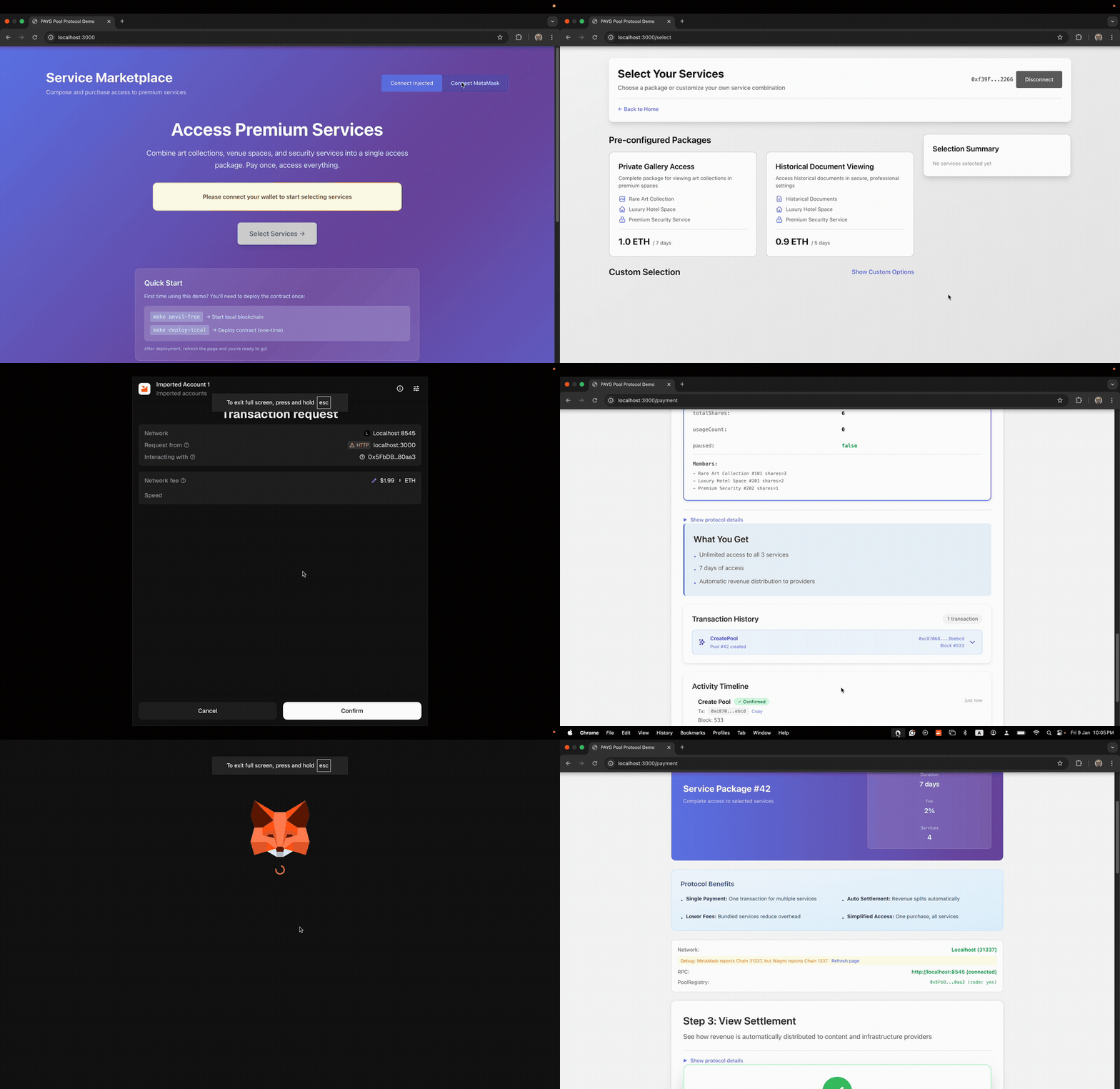
This animation shows the complete flow in a local environment. The contracts are deployed to Anvil, transactions are real (even if on a local chain), and you can see exactly how the protocol handles multi-provider settlement atomically.
Beyond the Demo
Moving from raw registries to a composed “Gallery Access” package taught me one thing: Web3 doesn’t need to be complicated to be useful. The goal was to prove that we can take a messy real-world event and turn it into a single, purchasable transaction. No more managing three separate contracts or manual splitting—just one checkout.
The code is open-source, the demo is live, and the protocol is ready. Check out the Service Marketplace and let me know what you think.
Explore the Project:
- Live Demo: Service Marketplace (Mock Mode available)
- Smart Contracts: GitHub Repository
- Web UI Source: Demo Implementation
This is the final part of my PAYG series. You can find the full progression from initial Solidity experiments to the composition layer in my blog archives.