Who Owns Execution on Solana?
Part I measured retail pricing at the app. Part II opened one unsigned transaction for router attribution. This piece is a seven-day probe of Jupiter’s managed /order path: selected-router incidence stays dispersed, but the large leave-one-out gaps sit in a few pair×size×state corners—not across the router layer as a whole.
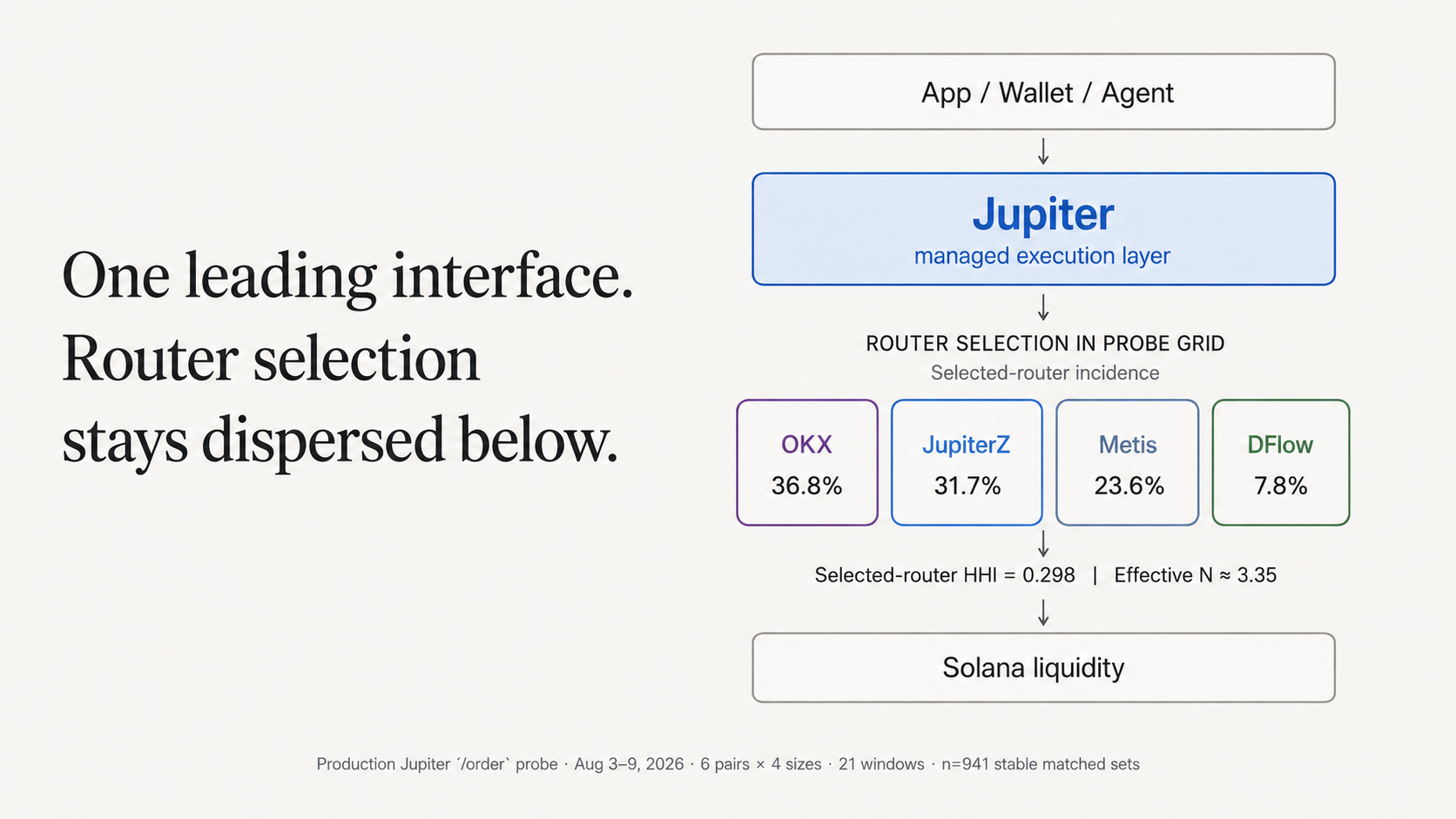
/order probe—not transaction volume, notional share, or landed fills.
One Interface, Many Execution Sources
Solana liquidity sits across AMMs, books, and market makers. Most traders never see that stack. They enter through a small number of swap interfaces.
Jupiter was the largest DefiLlama-attributed Solana aggregator series in 15/15 months from May 2025 through July 2026. Those adapter series are not a mutually exclusive partition of execution flow, so they enter here only as persistent interface-level attribution—not as market share.
Jupiter is also not a single router. Its managed Meta-Aggregator /order path (Ultra during this collection lineage) runs a selection layer containing Metis, JupiterZ, DFlow, and OKX, and returns which label was selected. Interface adoption and selected-router incidence are different objects.
This is a fixed pair×size×time probe grid, not a draw from Jupiter’s production order flow. Each tested intent counts once regardless of notional. The router percentages below are incidence inside this experiment—not production flow share, notional share, or landed execution share.
An app can also buy execution outside that managed race. Parts I–II retain one unsigned JTX→DFlow Aggregator v4 transaction—an alternate wiring, not evidence that any one source dominates Jupiter’s internal selection.
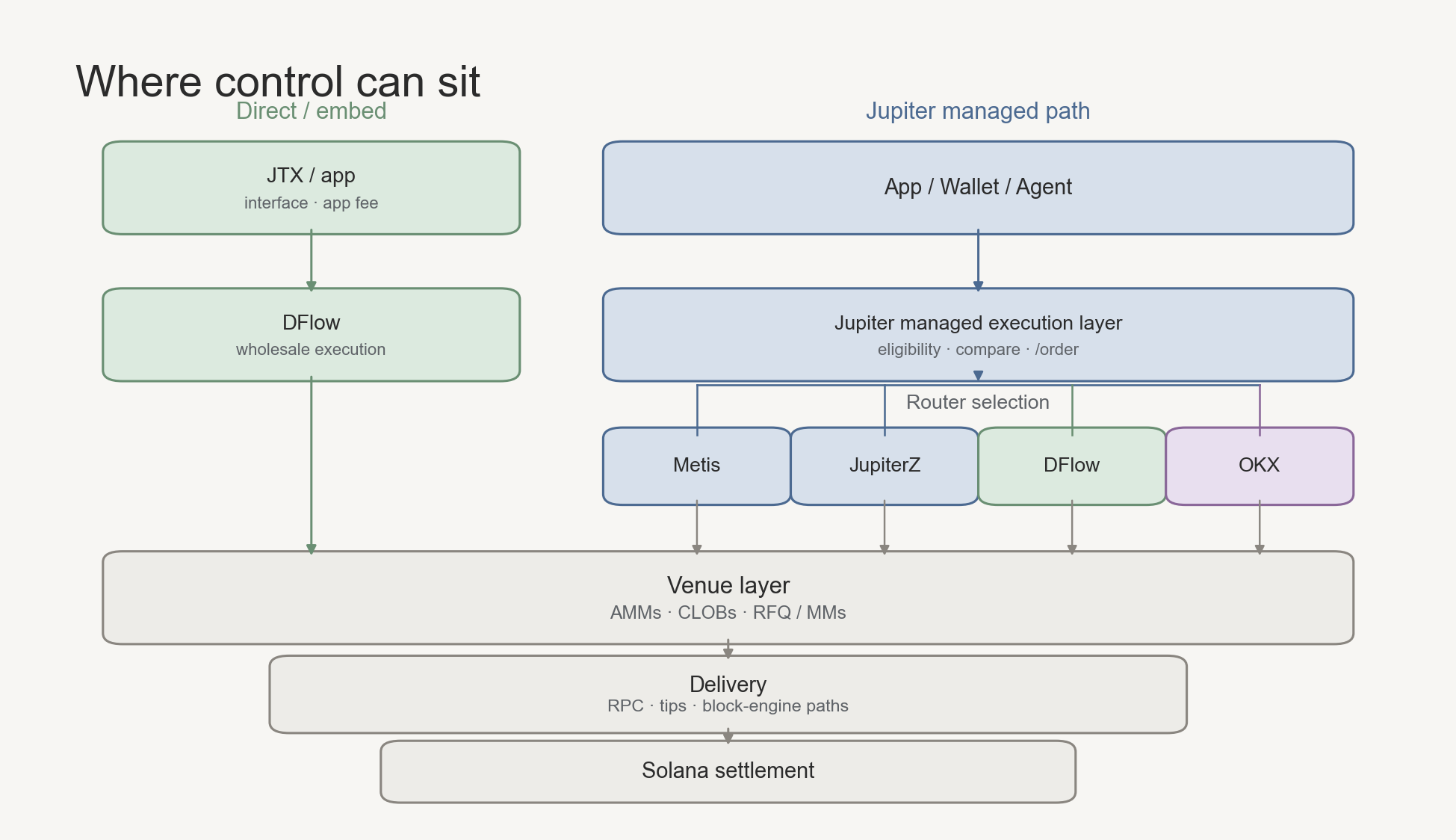
/order. Schematic only—arrows are not volume.
Jupiter Runs the Managed Execution Layer
Panel B0-extended measured selected-router incidence across 21 UTC windows (2026-08-03→08-09). Selected-router HHI stayed between 0.28 and 0.35, with overall HHI 0.298 (effective number of routers about 3.35). No single router label took half or more of the tested intents.
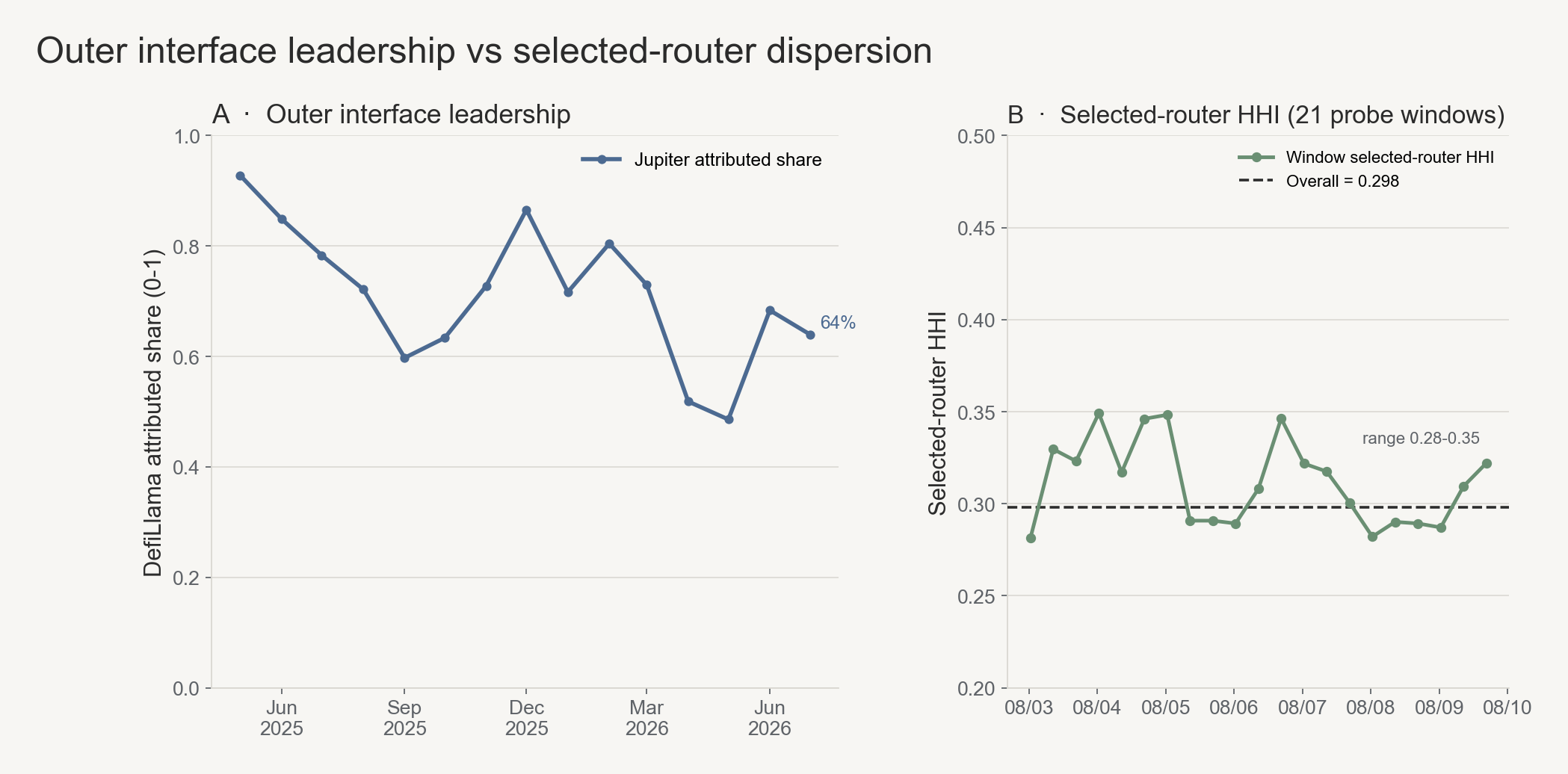
The managed /order path decides eligibility (excludeRouters), compares offers, and returns amounts plus a transaction when build succeeds. This probe stops at the order stage, so the stored responses do not support router-level buildability or landing comparisons.
JupiterZ is Jupiter-operated. Metis is treated separately: Jupiter formally separated Metis v7 from the Jupiter umbrella in late 2025 while still listing Metis as a 2026 Meta-Aggregator engine. Jupiter-operated selected incidence is therefore a bound—31.7%–55.3%—depending on how Metis is classified.
Who Gets Selected Is Not Who Matters Most
The probe: six USDC pairs × four sizes × three UTC windows/day for seven days, leave-one-out for Metis, JupiterZ, DFlow, and OKX. 21/21 windows completed; 941 stable matched sets of 1008 attempted.
Sign convention. Leave-one-out bps:
\[\mathrm{LOO}_r = 10{,}000 \times \left( \frac{q^{\mathrm{all}}}{q^{-r}} - 1 \right),\]where $q^{\mathrm{all}}$ is the midpoint of the bracketing all-router quotes (out_all_ref) and $q^{-r}$ is the exclude-$r$ quote (out_exclude_r). Positive means excluding $r$ worsened measured output.
Leave-one-out estimates are conditional on brackets whose all-router endpoint drift stayed below 5 bps; high-drift brackets were dropped. On the stable sets, median $\lvert\Delta_{AA}\rvert$ is about 0.26 bps (P95 about 2.75). Among brackets with both endpoints observable, pre-gate $\mathrm{P}(\lvert\Delta_{AA}\rvert > 5\,\mathrm{bp})$ is about 4.8%. Stable-set $\mathrm{P}(\lvert\Delta_{AA}\rvert > 5\,\mathrm{bp})$ is censored by the gate—not a tail benchmark.
JupiterZ selection also rises in those high-drift brackets after accounting for pair composition (pair-standardized expected share about 49%, observed about 65%). The stable-bracket results therefore miss some states where JupiterZ is selected more often.
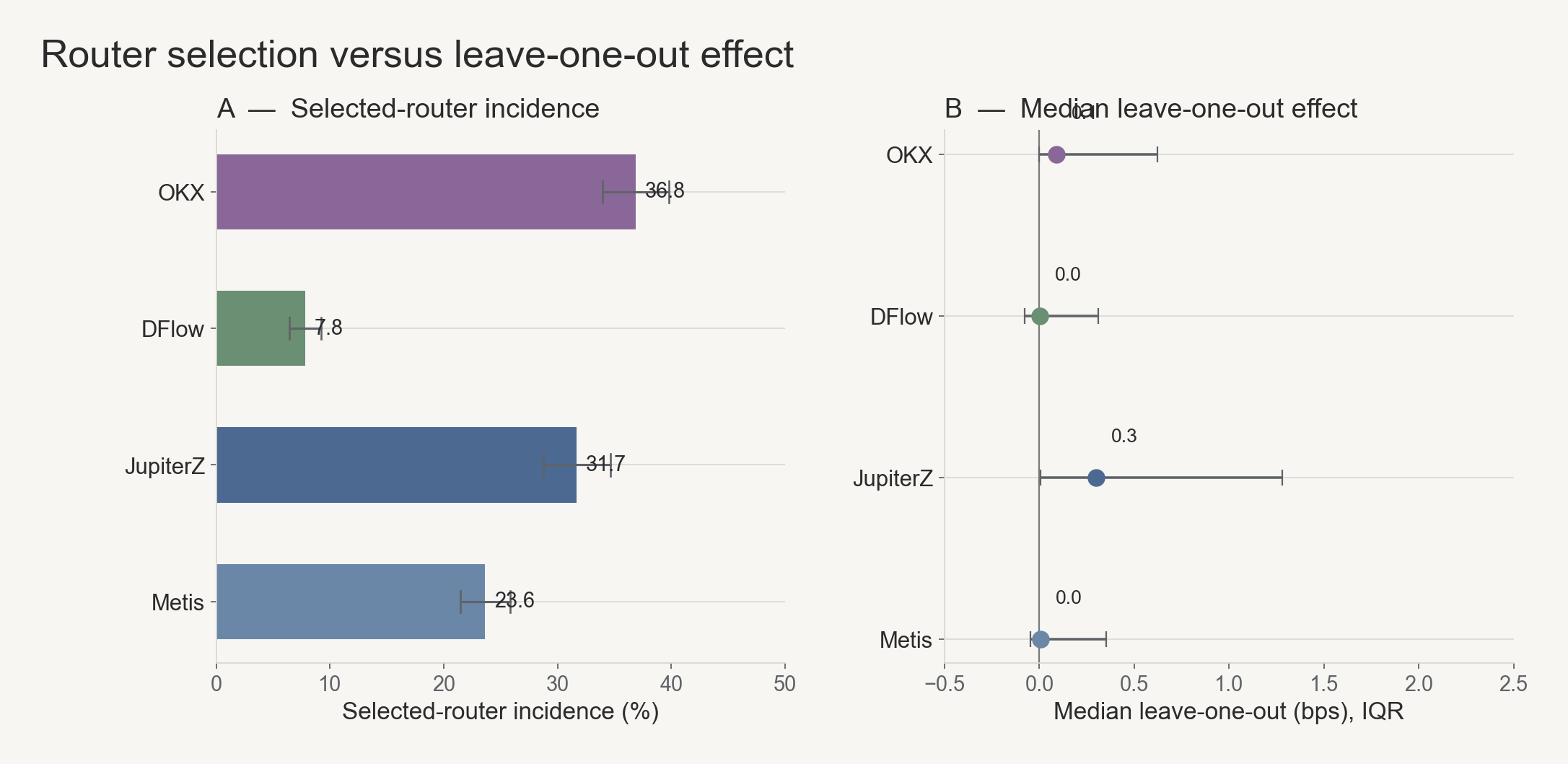
Across successful all-router responses (A1 and A2 pooled; n = 2014), OKX was selected in 36.8% of tested intents, JupiterZ 31.7%, Metis 23.6%, DFlow 7.8%.
Aggregate leave-one-out medians sit near that resolution: Metis and DFlow about 0 bps, OKX about 0.1, JupiterZ about 0.3. Hard coverage failure was almost absent—another routing source usually returned a valid quote. A valid fallback is not always an economically close substitute. Most stable brackets have a replacement path and aggregate median effects near probe resolution. The large gaps sit in specific pair×size×fallback×state cells.
Exclusion scope. Docs keep Metis eligible when excludeRouters=jupiterz, and separately state that JupiterZ V2 MM liquidity is integrated into Metis as hops. Stored Metis routePlan labels never expose a JupiterZ hop—under either the all-router or exclude-JupiterZ arm—so the schema does not show whether embedded inventory is also disabled. No bias direction is assigned. The exclude-JupiterZ arm identifies execution-path dependence, not a clean standalone-router valuation.
Dependence Is Concentrated by Pair, Size, and Path
Large exclude-JupiterZ effects are not a general property of the probe. They occur in two pairs: AAPLX and BONK. In the other four pairs, no stable set exceeds 5 bps.
On stable sets, exclude-JupiterZ LOO exceeds 5 bps in 60.4% of AAPLX sets (n = 144; median 21.5 bps) and 34.2% of BONK sets (n = 146). BONK’s median is small (~0.7 bps), but roughly one-third of its stable sets still clear 5 bps. For SOL, USDT, JITOSOL, and CBBTC the >5 bp rate is 0%.
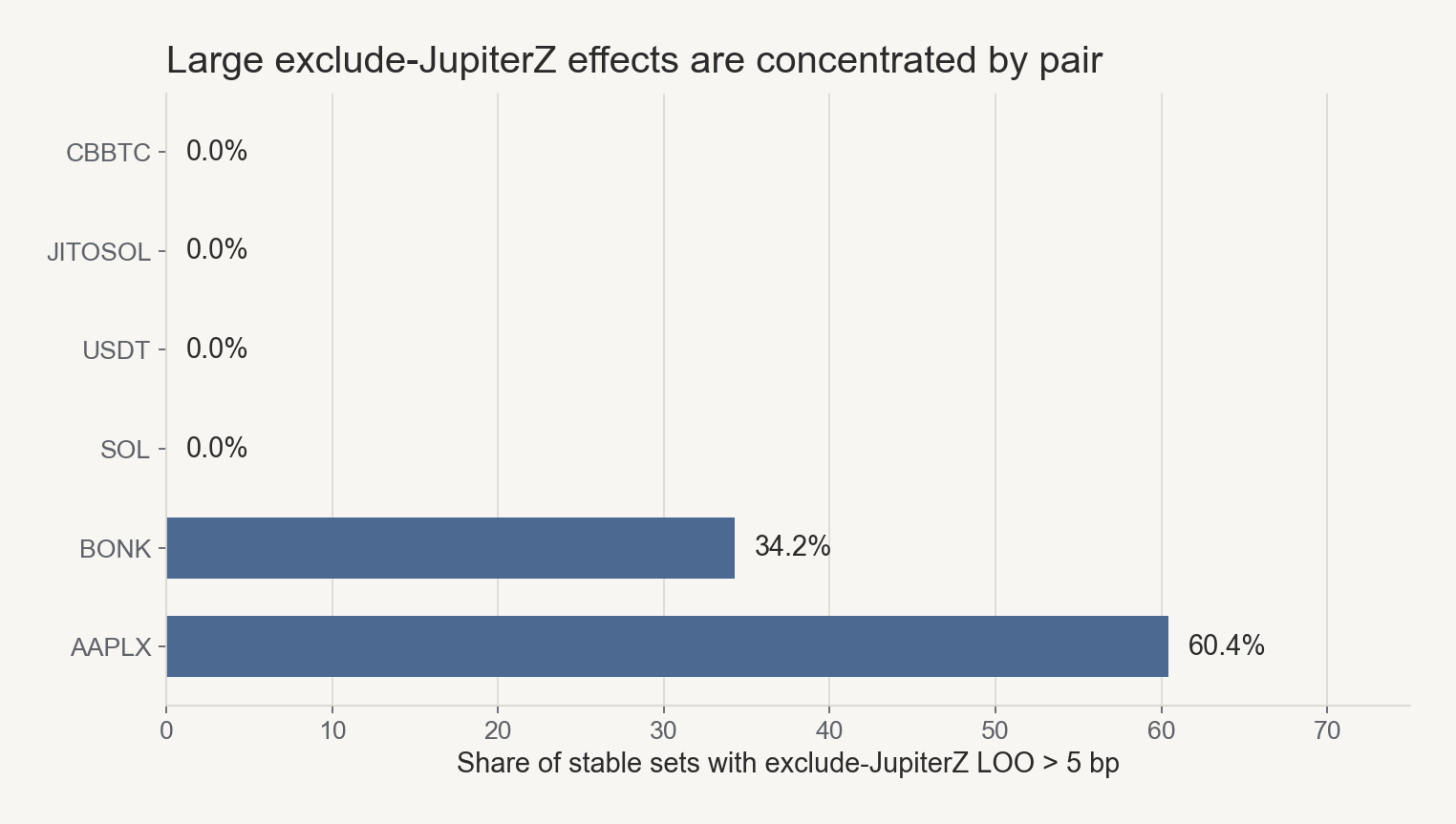
excludeRouters=jupiterz.
The AAPLX cell is the maximum of 24 pair×router medians; it was identified post hoc. The 21.5 bp AAPLX median sits far above its 0.05 bp local drift median—roughly six times the pair-specific P95 full-bracket drift (3.39 bps). Leave-one-day-out medians stay in 16.6–30.6 bps.
The AAPLX gap is strongly size-dependent. Medians: about 0 bps at $100 (n = 39); 19 bps at $1k (n = 41); 185 bps at $10k (n = 36); about 16,800 bps at $100k (n = 28). The $100k cell is also where the extreme-value audit concentrates.
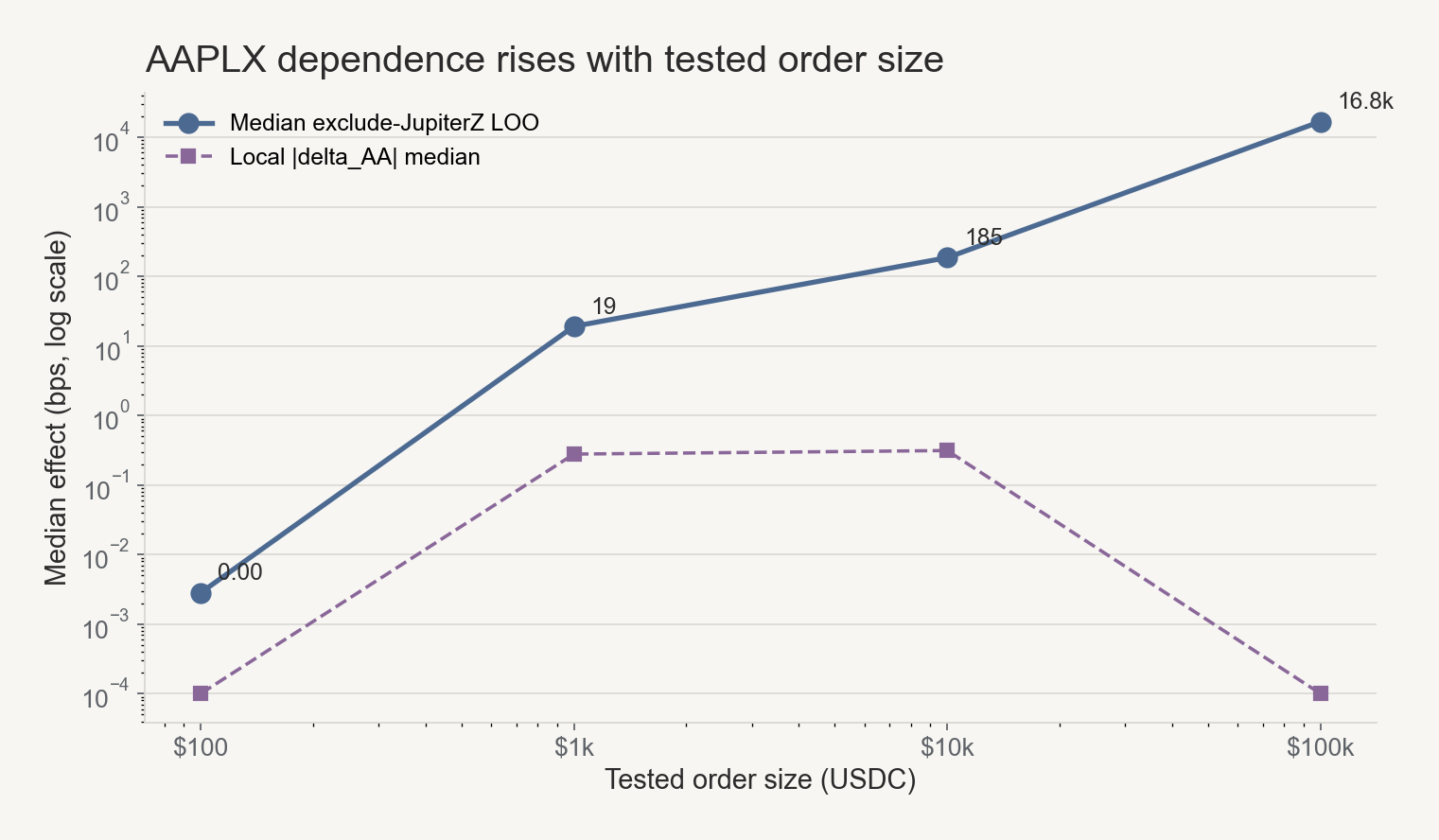
Hard coverage and replacement quality are different objects. Among stable sets where JupiterZ won A1, Metis and OKX fallbacks typically preserve the all-router reference (median remaining output ~ 1.00). The extreme AAPLX tail concentrates in the rare JupiterZ→DFlow fallback (n = 18), where the median fallback returned about one-fifth of the all-router reference (median remaining-output ratio ~ 0.20). The leave-one-out result measures the quality of the available replacement path—not a standalone price tag on JupiterZ.
The sharper calendar contrast is weekday versus weekend, not U.S. hours alone: weekday U.S.-hours overlap median 24.4 bps (n = 30); weekday off-hours 54.2 bps (n = 68); weekend 0.01 bps (n = 46), though roughly 28% of weekend observations still exceed 5 bps. Onchain xStocks are documented as 24/7 tradable; no depth or market-closure mechanism is claimed here.
Closing
In this fixed /order probe, Jupiter controls the managed entry and comparison layer. Selected-router frequency is a poor proxy for economic dependence: most single-source exclusions have aggregate medians near within-bracket resolution, and a valid fallback quote usually exists.
The large gaps sit in corners of the test grid. Under excludeRouters=jupiterz, only AAPLX and BONK produce >5 bp events. On AAPLX, the effect rises sharply with tested order size and differs between weekday and weekend observations. The extreme tail also depends on which fallback path remains available.
Because that exclusion may not isolate a clean standalone router, these results identify execution-path dependence rather than a standalone valuation of JupiterZ. They are order-stage selection and quote-sensitivity results from a fixed probe—not production-volume shares or landed fills.
Appendix
- Sample. Production Meta-Aggregator
/order,b0x_20260803(2026-08-03→08-09). Matched set = A1 + 4 randomised LOO + A2. 1008 attempted → 941 stable ($\lvert\mathrm{A1}-\mathrm{A2}\rvert$ < 5.0 bps; span ≤ 20 s). Pre-gate high-drift rate ~4.8%. - Resolution. Stable $\lvert\Delta_{AA}\rvert$: median ~0.26 bps, P95 ~2.75. Pre-gate (n=1006): median ~0.29, P95 ~4.39. Stable $\mathrm{P}({>}5)/\mathrm{P}({>}10)$ are gate-censored.
- Denominators. Incidence pools A1+A2 (n=2014). Substitution counts use the A1 winner on each stable set (n=941).
- Scope. Metis affiliation unresolved (Jupiter-operated bound 31.7%–55.3%). JupiterZ exclusion semantics unresolved. No landed fills; no production-volume read. Diagnostics: empirical package.
- Part I: Different Apps, Same Router · Part II: Can a Solana Transaction Prove the Router? · Jupiter
/order