Metering Chain Phase 2: Deterministic Authorization for Multi-Operator DePIN
In the first post, Metering Chain showed that usage can be replayed into deterministic balances: same history, same bill. That part worked. What kept nagging me was the more dangerous question:
Who is allowed to submit usage?
Without signatures, anyone can impersonate a user or operator. Phase 2 adds cryptographic authorization so the system stays deterministic and becomes permissioned.
The easiest way to think about Phase 2 is as an access-control gate. Operators don’t “submit usage” just because they can. They present a signed message, and only messages that pass verification are admitted into the log. The append-only property holds because invalid entries never enter the state machine in the first place.
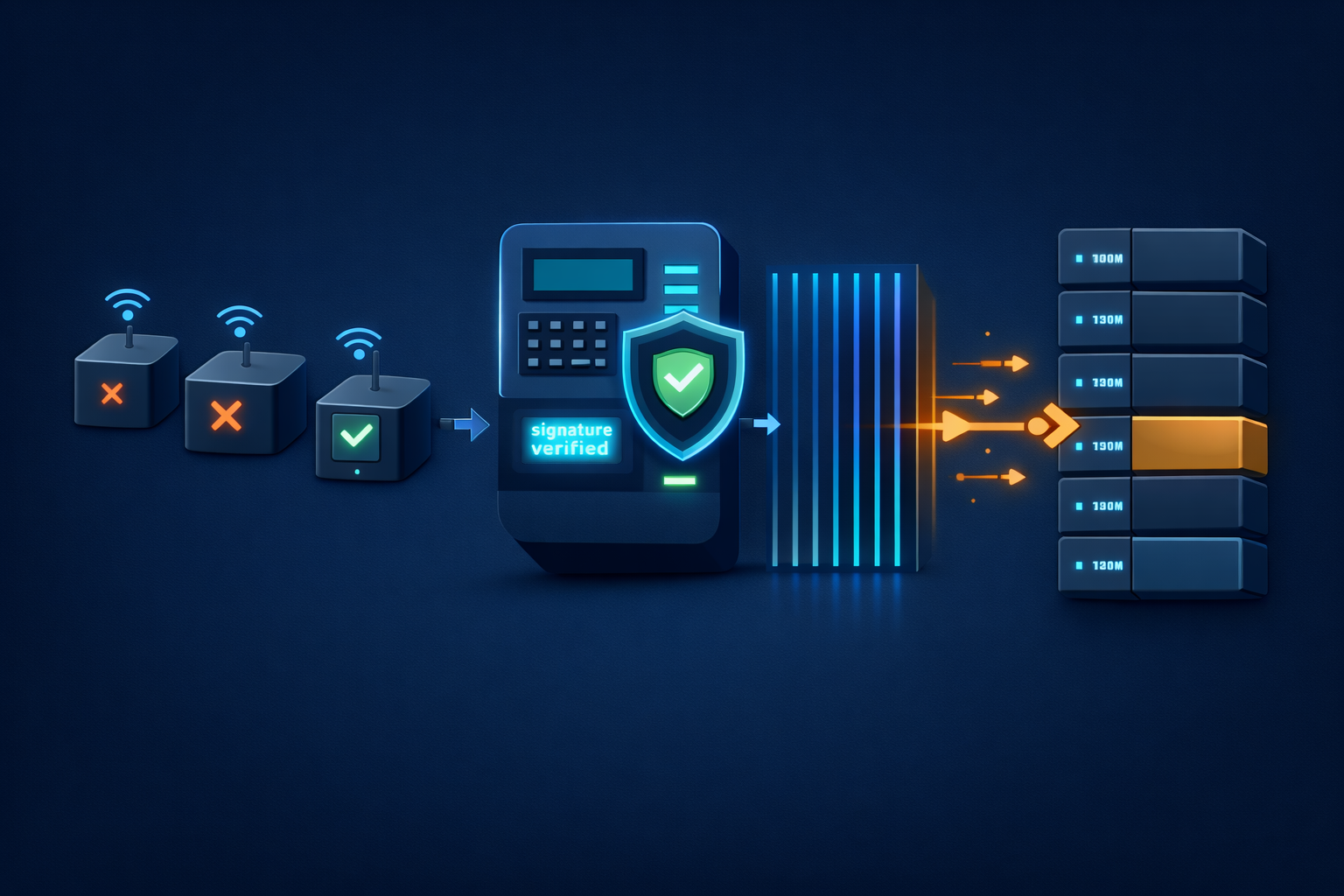
Phase 1 proved reproducibility: feed transactions, replay, same balances. But it didn’t solve who can create those transactions. An unsigned Consume could be fabricated. An unsigned Mint could inflate supply. In a multi-operator DePIN (many hotspots, many reward events), you need to know that usage comes from the right actor.
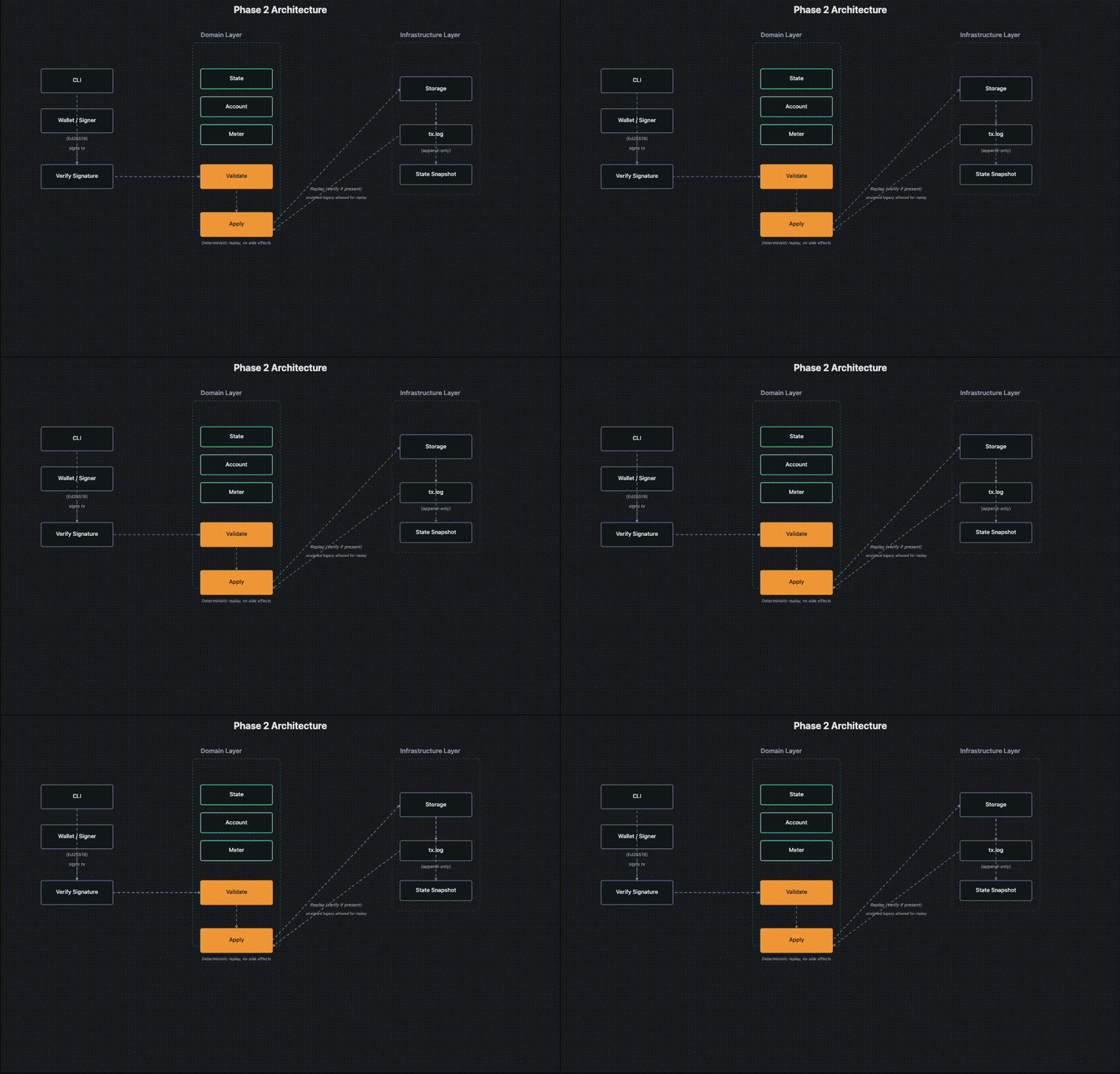
Phase 2 makes every transaction signed and verified before it hits domain logic.
- Domain layer: invariants only — signer must match owner (or minter for
Mint), nonces must increment. - Infrastructure layer: wallet creation, signing, verification.
Changes under the hood, in plain terms:
SignedTxnow carries an Ed25519 signature over a canonical payload.applyverifies signatures before it validates domain rules.- Unsigned tx are rejected by default; legacy replay can use a flag
--allow-unsignedif you really need it.
Flow: wallet create → build kind-only JSON → wallet sign --address <signer> --file kind.json → pipe to apply. Signing uses the current nonce from state, so tx must be applied in order.
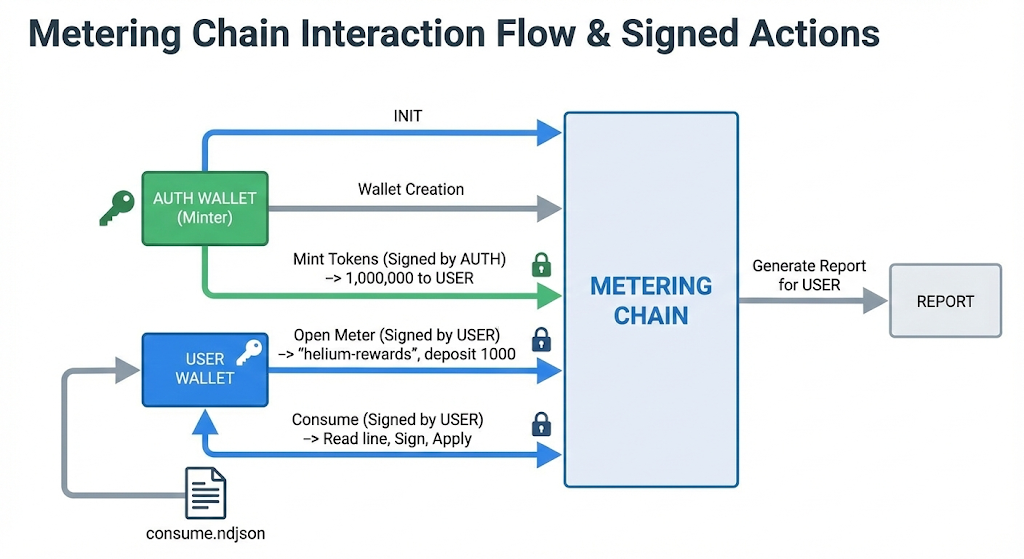
consume.ndjson) → Report. Full script: run_signed_demo.sh.
Wallet / signer
Signing builds the canonical message and attaches an Ed25519 signature; verification runs before apply. I kept the domain rules boring and strict, and pushed the “who signed this” decision to the boundary.
// sign_transaction (wallet.rs)
pub fn sign_transaction(&self, nonce: u64, kind: Transaction) -> Result<SignedTx> {
    let tx = SignedTx::new(self.address.clone(), nonce, kind);
    let message = tx.message_to_sign()?;
    let signature = self.sign_bytes(&message);
    Ok(SignedTx { signature: Some(signature), ..tx })
}
Note: code snippet from src/wallet.rs
Data format & replay
Deterministic replay depends on byte-level stability, so the details are a bit pedantic here. Address = 0x + hex(32-byte Ed25519 pubkey). Canonical signing payload = bincode of SignablePayload { signer, nonce, kind } (no signature included in the bytes being signed). tx.log continues to be bincode; replay verifies signatures when present and accepts the legacy layout (no sig) for backward compatibility.
// message_to_sign (tx/transaction.rs)
pub fn message_to_sign(&self) -> Result<Vec<u8>> {
    let payload = SignablePayload { signer, nonce, kind };
    bincode::serialize(&payload)
}
Note: code snippet from src/tx/transaction.rs
Helium IOT: 17k rows, 1.5k operators
DePIN is inherently multi-operator, so I wanted a dataset that is public, messy, and real. Helium IOT transfers fit that well. We pull from Dune Analytics tokens_solana.transfers, Helium IOT mint iotEVVZLEywoTn1QdwNPddxPWszn3zFhEot3MfL9fns, treat each to_owner as an operator (hotspot), aggregate by operator, and map into Consume.
Data source: Dune Analytics, tokens_solana.transfers, Helium IOT token. Window: 2026-01-01 → 2026-01-31.
| Metric | Value |
|---|---|
| Rows | 17,820 |
| Distinct operators | 1,561 |
| Total units | 659,978,351,356,954 |
Pipeline (4 steps):
- Fetch Helium IOT transfers from Dune →
helium_rewards.csv - Analyze with
analyze_rewards.py→ charts +helium_jan_summary.json - Convert CSV to Consume NDJSON with
helium_rewards_to_consume.py→consume.ndjson - Signed apply — init, Mint, OpenMeter, then sign-and-apply each line
Full scripts live in examples/multi_operator.
When top 10 hold 70%
The Helium Jan dataset is highly concentrated. A small set of operators has outsized influence:
| Metric | Value |
|---|---|
| Top-10 share | 70.6% |
| HHI | 0.116 |
| Gini | 0.958 |
This isn’t just a pretty plot. If the top 10 operators control most rewards, authorization isn’t optional: it’s the only way to keep the ledger honest.
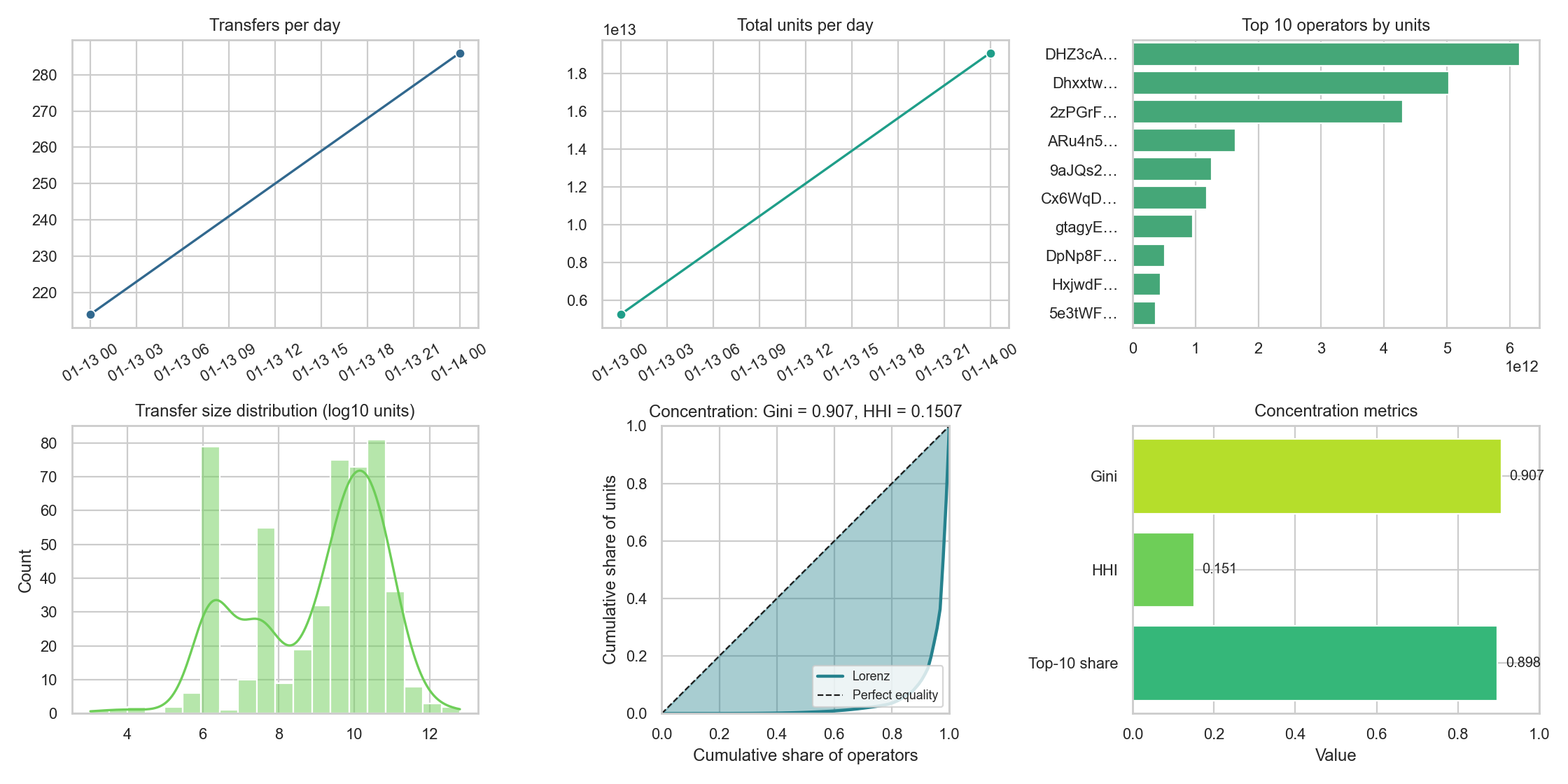
The Lorenz curve (blue) is cumulative operators vs. cumulative units earned; the diagonal would be perfect equality. Gini, HHI, and Top-10 share are different angles on the same skew. That’s why Phase 2 focuses on who signs, not just how much.
One run, one report
I ran the demo with real Helium IOT data (500 rows from Dune, 92 distinct operators aggregated) and captured the output below. Same pipeline as above: fetch → convert → signed apply. The reassuring part: replaying the same signed tx.log reproduces the exact numbers.
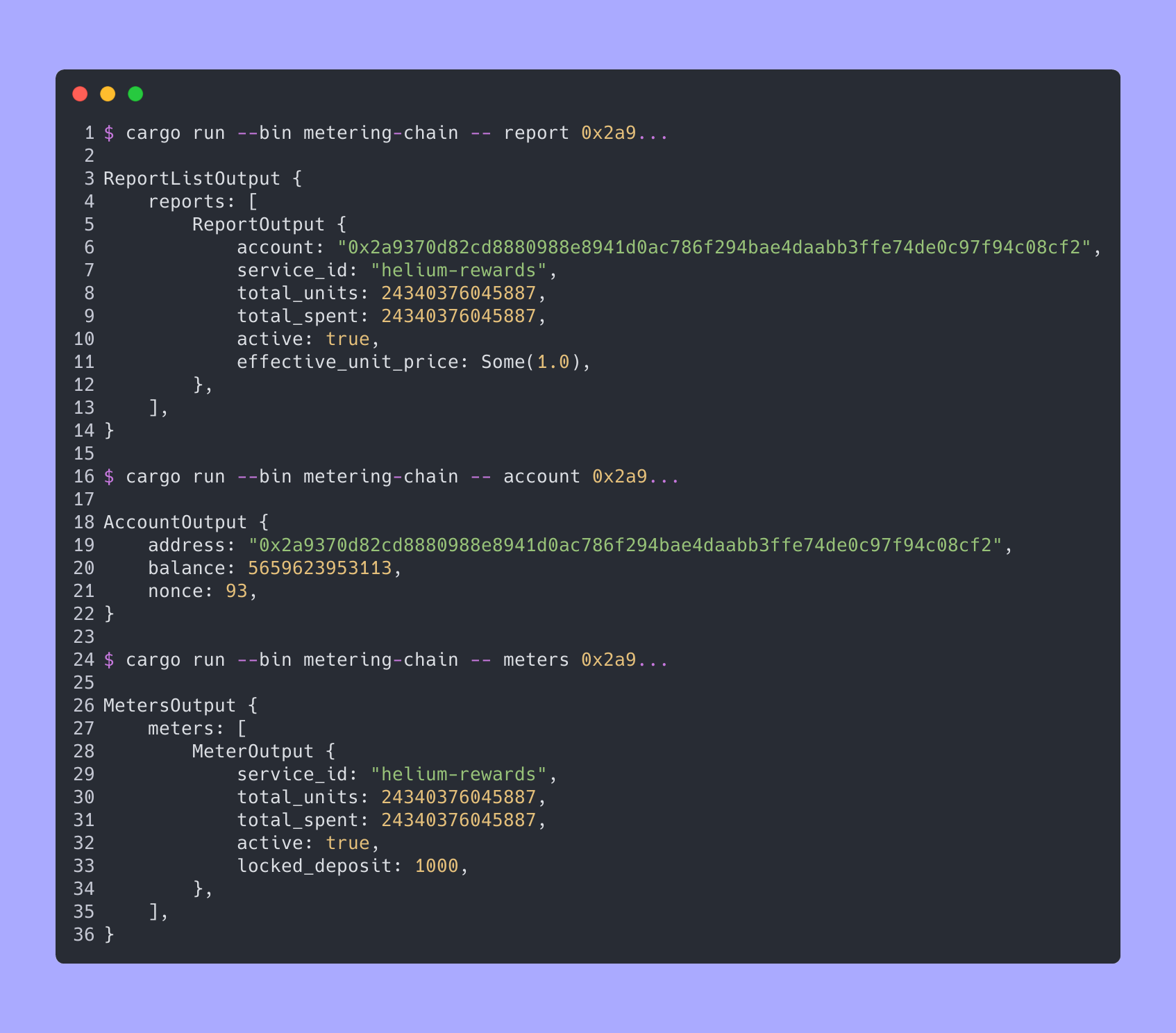
tx.log gets the same numbers.
Numbers from this run:
- Account: balance 5,659,623,953,113, nonce 93
- Report:
helium-rewardsmeter, 24,340,376,045,887 units consumed, unit price 1.0 - Meters: one active meter, deposit 1,000 locked
Auditability, non-repudiation, delegation
Same inputs → same outputs; replay the log, same balances. Only the right actor can produce valid inputs: Consume signed by the meter owner, Mint by the authorized minter. No signature, no apply. That gives you auditability (who did what, verifiable from signatures), non-repudiation (the signer can’t deny it), and a path to delegation (Phase 3: UCAN/ReCaps so operators can act on behalf of accounts without sharing keys).
Delegation (Phase 3, out of scope)
Phase 2 deliberately stops at authorization. Delegation is the next layer:
- UCAN / ReCaps: scoped operator rights — “this hotspot can Consume on behalf of account X for service Y” without handing over the root key.
- Device attestation: TPM/WebAuthn for hardware-backed operator identity.
- Optional MetaMask / EIP-712: familiar wallet UX for account owners.
The repo lives at egpivo/metering-chain. Phase 1 demo: examples/depin/. Phase 2 signed demo: examples/signed/ and examples/multi_operator/.