Metering Chain Phase 3: Capability-Driven Delegation
In DePIN, owners can’t sign every event, and letting operators submit usage without proof opens a trust hole. Phase 3 adds delegation: the owner issues a signed capability proof; the delegate signs Consume and attaches it. Same usage, different outcome depending on authorization — no proof gets rejected, valid proof gets accepted, revoked proof gets rejected.
Phase 1 proved deterministic accounting. Phase 2 proved deterministic authorization. Phase 3 adds delegation: a delegate can submit Consume for an owner without using the owner’s private key.
Core shift:
Usage does not change; who is allowed to speak does.
Why Phase 3 exists

In real usage systems (DeWi, API billing, AI/compute), the owner cannot sign every event. But letting operators submit usage creates a trust problem:
- Who is authorized to charge?
- What service is in scope?
- How much can be charged?
- Can anyone audit and replay the result?
Phase 3 turns these into verifiable constraints in signed transaction input. Below, the flow: owner issues proof, delegate submits Consume(v2) with proof, validator applies and appends to tx.log.
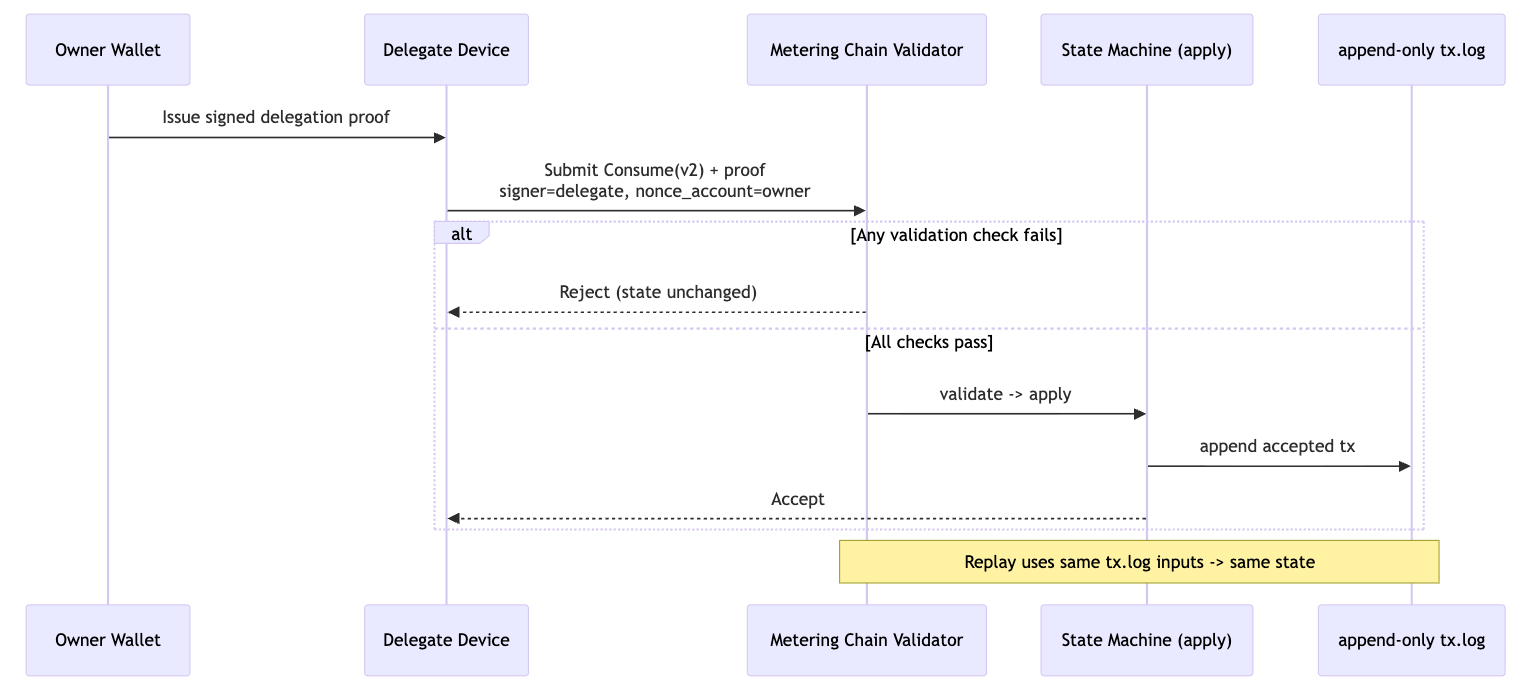
What changed in Phase 3
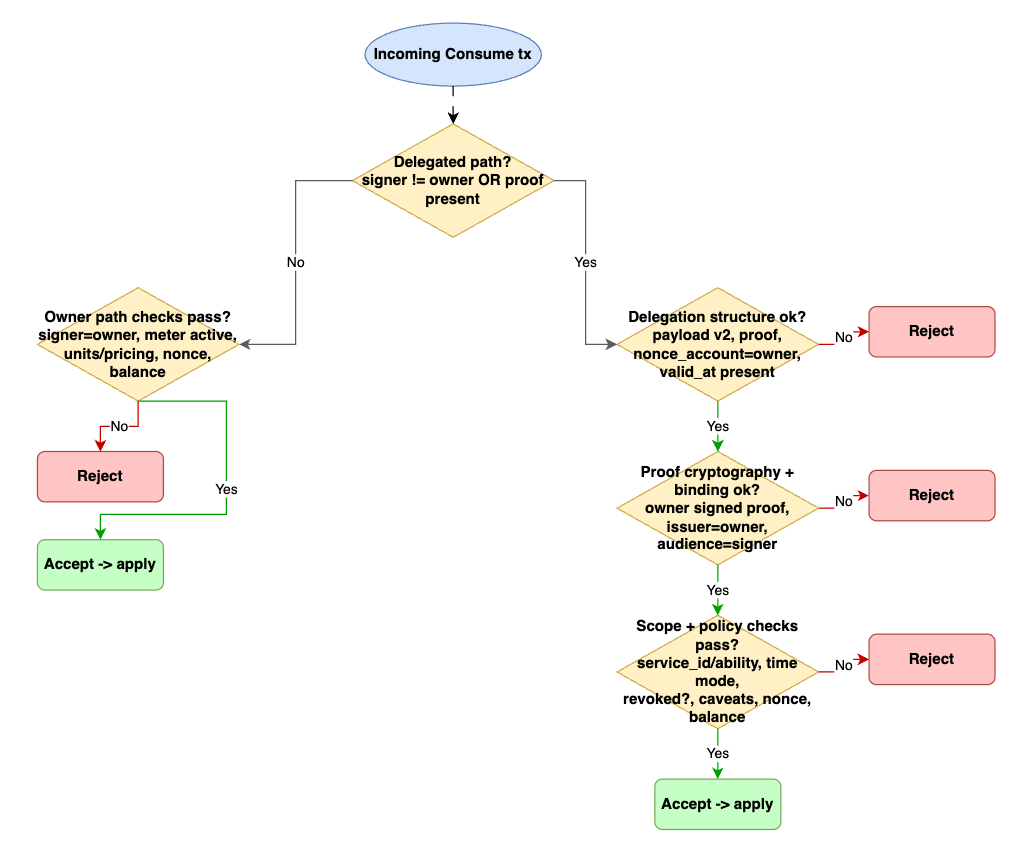
Delegated consume requires payload_version=2 and owner-signed proof; no proof, no apply. Details:
- Owner-nonce: delegate consumes owner’s nonce (
nonce_account=owner), not their own. - Revocation:
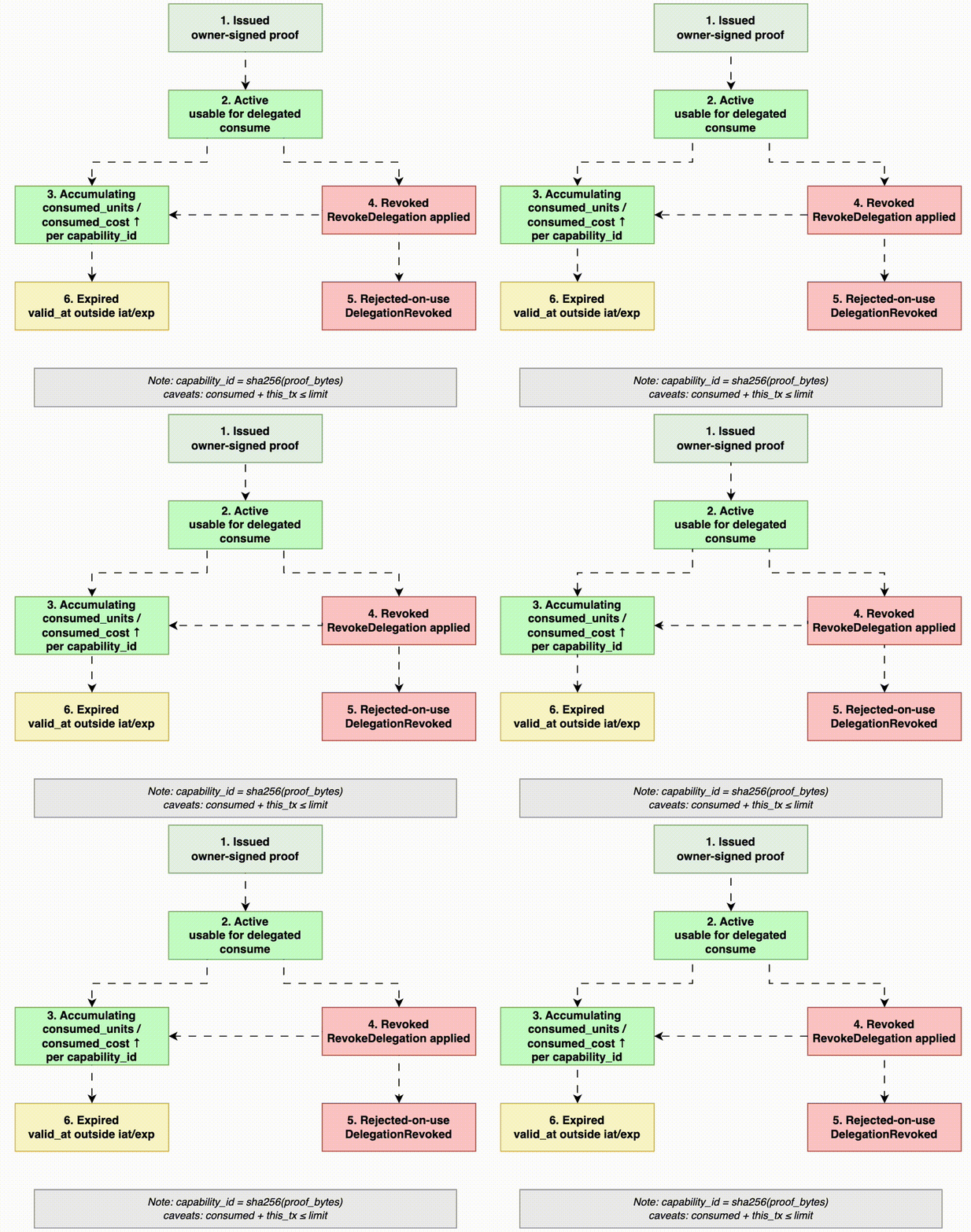
RevokeDelegationaddscapability_idto revoked set; reusing a revoked proof fails. - Proof format: owner-signed canonical
bincode(not JWT); issuer and audience bind to owner and signer. - Principal format:
0xhex ordid:key(Ed25519). - Scope match: must match the transaction’s
service_id(and optionalability). - Capability identity:
capability_id = hash(proof_bytes), deterministic. - Caveat: optional bounds like
max_unitsormax_costto limit delegated spend. - Replay time model:
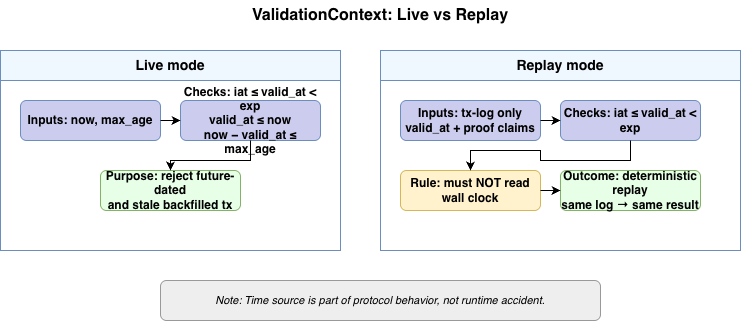
ValidationContext(Live/Replay)— Live uses wall clock, Replay uses tx reference time, which keeps determinism.
Demo: who can act on behalf of another?
Phase 3 answers one question: who can act on behalf of someone else? The demo runs four scenes. In Scenes 1–2, a delegate signs Consume without a proof — rejected. In Scene 3 the owner issues a delegation proof and the same Consume goes through. In Scene 4 we revoke the capability; sending Consume again with the same proof returns Delegation revoked. Same usage, same amount, different authorization outcome.
Try it
# Run from egpivo/metering-chain repo root
./examples/phase3_demo/run_phase3_demo.sh
Repo: egpivo/metering-chain. The script initializes a temporary data dir, creates three wallets (authority, owner, delegate), runs Mint and OpenMeter, then runs the four scenes above. Output lines like “Expected: rejected.” or “Expected: accepted.” indicate the expected outcome. Manual steps: examples/phase3_demo/README.md.
Demo outcomes (one run)
| Scene | Action | Expected | Result |
|---|---|---|---|
| 1–2 | Delegate signs Consume (no proof) | Reject | Delegated Consume requires payload_version=2 |
| 3 | Owner issues proof → delegate signs same Consume | Accept | Transaction applied, Cost: 20 |
| 4 | Owner revokes → delegate retries with same proof | Reject | Delegation revoked |
Scene 3 success: after the delegate signs with a valid proof, the state shows the owner’s updated balance and meter:
--- Scene 3: Owner issues proof, delegate signs (expected accept) ---
Created signed delegation proof: 254 bytes
Transaction applied successfully  Cost: 20
Expected: accepted.
AccountOutput { address: "0xc89176c9...", balance: 880, nonce: 2 }
MetersOutput { service_id: "storage", total_units: 10, total_spent: 20, active: true, locked_deposit: 100 }
Phase 3 on real data
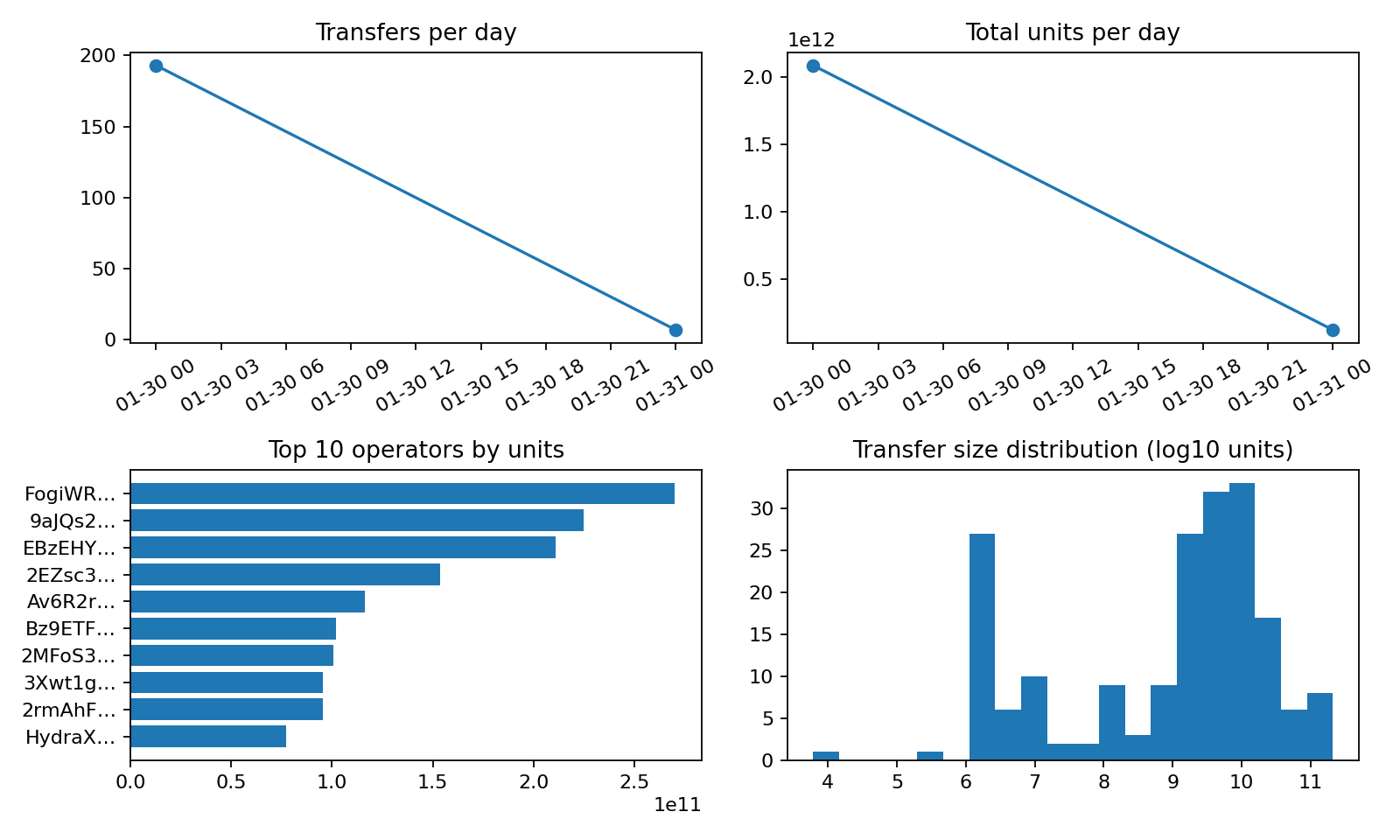
We ran the delegation demo on real Helium IOT transfers from Dune. Fetch, convert to Consume NDJSON, create one owner and N delegate wallets with N proofs, then run the four scenes. Without proof the batch is rejected; with proof it’s accepted. Revoke one capability and re-apply: Delegation revoked. Replay the applied log in a fresh state and the owner report matches. Run from egpivo/metering-chain repo root. Scripts live in examples/phase3_dune_demo/; result_summary_template.md for recording a run; run_fetch_and_viz.sh spits out helium_real_analysis.png.
Guarantees and boundaries
For accepted claims you get authorization validity (signature plus delegation proof), one-time semantics (nonce, anti-replay), deterministic replay (same log, same state), and auditability. What we don’t do: Metering Chain doesn’t prove physical-world truth. It won’t tell you whether a hotspot actually forwarded traffic or a GPU actually did work. It validates accounting truth over accepted claims, not oracle truth. Key distribution and network/transport layer stay out of scope for Phase 3 v1.
Why this matters beyond one app
This isn’t Helium-only logic. Same authorization and accounting flow works for DeWi traffic metering, GPU inference billing, API usage charging, agent budget enforcement. Units and service names change; the rest stays.
Summary
| Phase | Question answered |
|---|---|
| 1 | How is usage accounted? |
| 2 | Who can submit transactions? |
| 3 | Who can act on behalf of another? |
Phase 3 v1 ships as a deterministic delegation layer: UCAN-style capability verification in a protocol-grade state machine. We scoped it intentionally: validation and replay first, oracle and attestation later. Trust in actors gets replaced by verifiable constraints on actions.
Repo: egpivo/metering-chain. Run demos from repo root: examples/phase3_demo/ (toy), examples/phase3_dune_demo/ (real Helium IOT).
Terms
| Term | Meaning |
|---|---|
payload_version |
v1 = legacy (no delegation); v2 = required for delegated Consume (proof, nonce_account, valid_at). |
nonce_account |
Which account’s nonce is consumed; for delegated Consume, must equal owner. |
capability_id |
Deterministic hash of proof bytes; used for revocation and caveat tracking. |
valid_at |
Reference time in the signed tx; used for expiry checks (Live: wall clock, Replay: this value). |
caveat |
Optional bound on a capability, e.g. max_units or max_cost, to limit delegated spend. |