Metering Chain Phase 4: Settlement and Economic Finality
Phase 1 was about accounting. Phase 2 locked down authorization. Phase 3 added delegation.
Phase 4 is where money movement finally stops being “we think this is right” and becomes a process we can replay and defend.

Where Phase 4 hurts (in a good way)
The earlier phases answer “can we accept this usage?”
The uncomfortable question is: “when payout is challenged three weeks later, can we still explain exactly why this number is correct?”
That is what this phase adds:
- settlement records that bound payout strictly (no over-claim / no double-pay)
- disputes that can actually pause payout
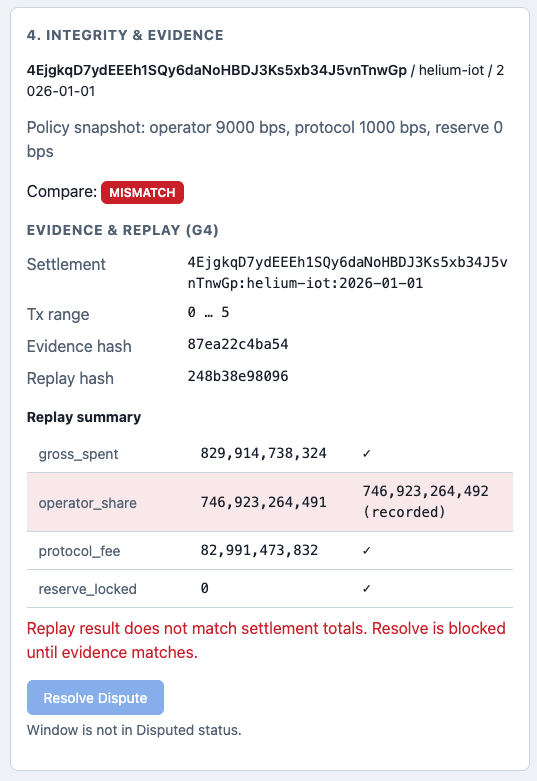
- a replay/evidence gate before a dispute resolution is accepted
What actually changed in the state machine
We added four tx kinds in the same append-only log: ProposeSettlement, FinalizeSettlement, SubmitClaim, PayClaim, plus dispute txs OpenDispute and ResolveDispute.
At the model level, a settlement now carries explicit economics:
gross_spentoperator_shareprotocol_feereserve_locked
And we enforce the boring-but-critical checks:
- one settlement per
(owner, service_id, window_id) gross_spent = operator_share + protocol_fee + reserve_locked- claim/payment cannot exceed finalized payable amount
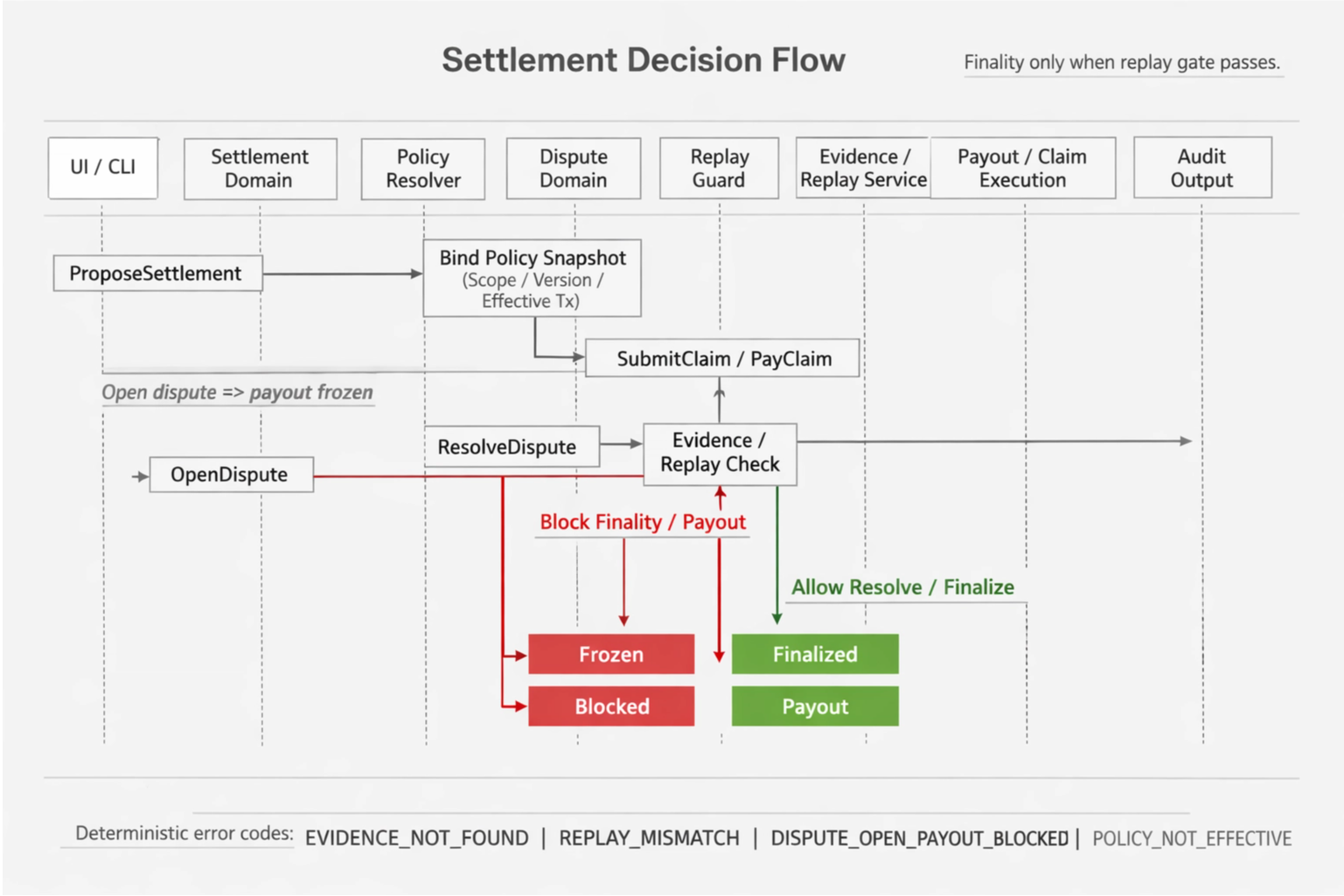
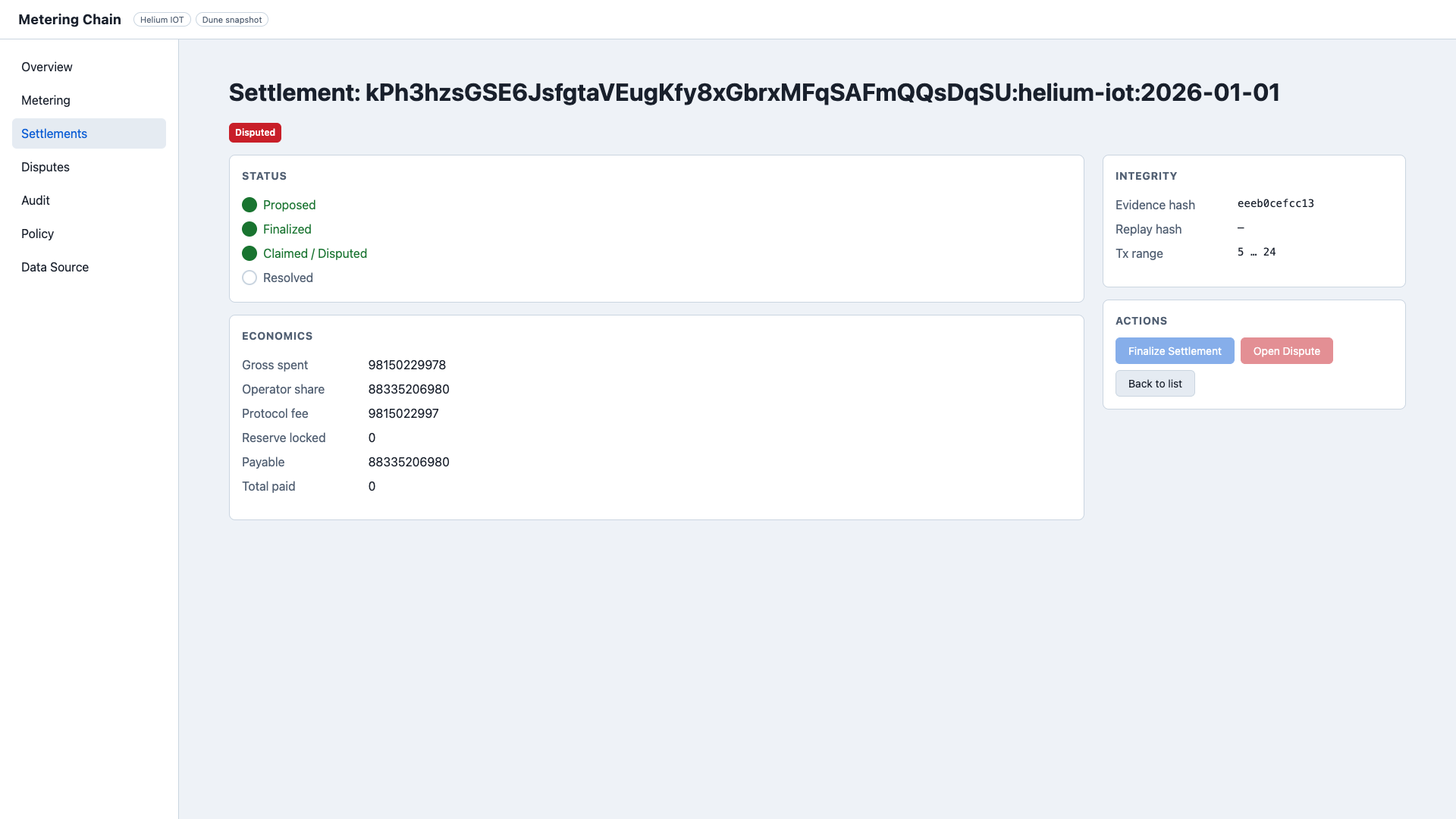
The practical behavior is simple: once OpenDispute succeeds, payout for that settlement is frozen until resolution.
ResolveDispute is not just a yes/no verdict. It passes through apply_with_replay_verifier, which checks that the submitted evidence bundle and replay output still match the settlement window before state is mutated.
Why hook-first (design decision)
I originally considered a deeper refactor before Phase 4, but the safer path for this repo was hook-first extension:
- keep the existing apply pipeline stable
- add settlement/dispute as new tx kinds
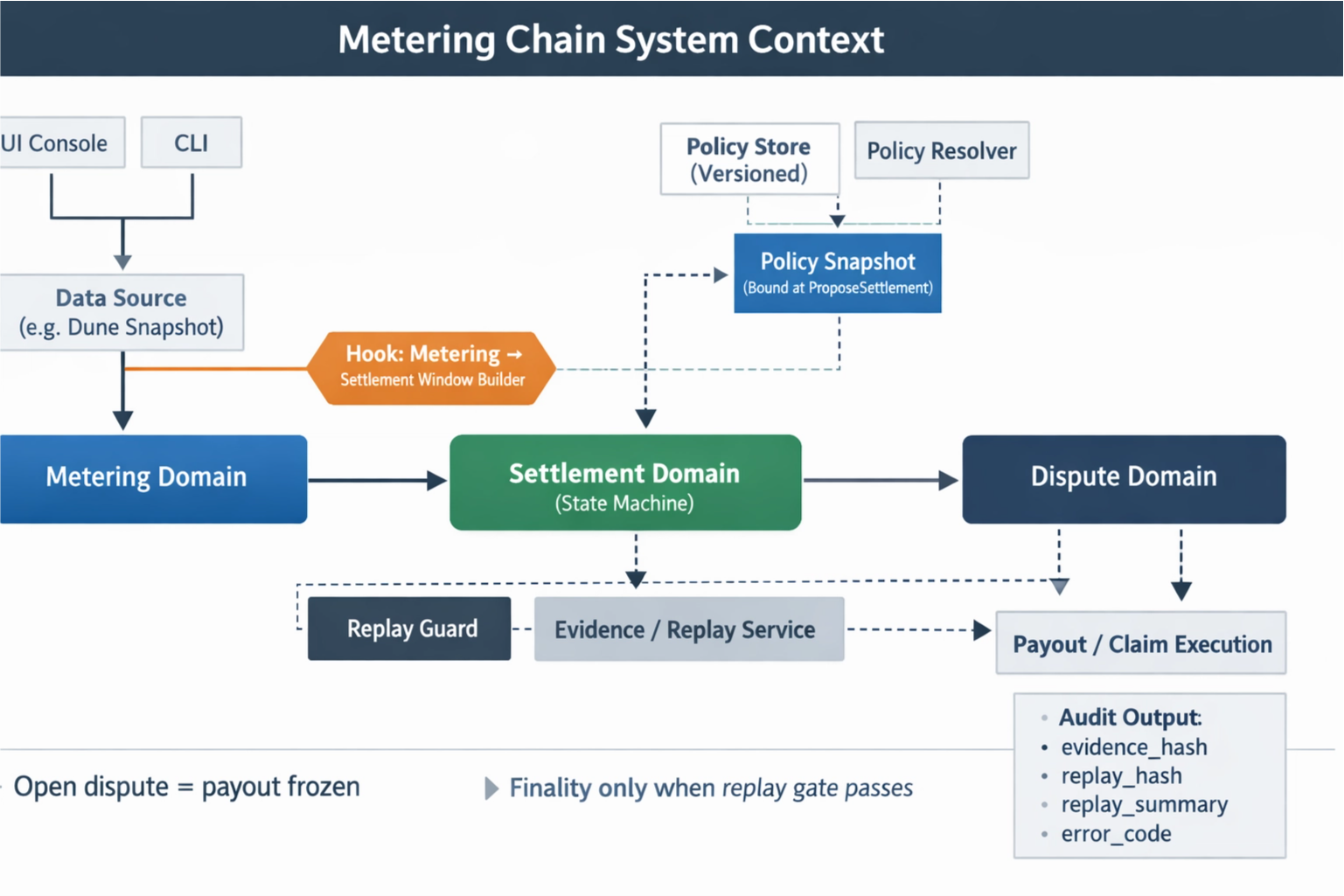
- intercept at explicit extension points (policy resolve, replay verify, payout gate)
- avoid deep wrapper chains and avoid touching proven Phase 1-3 behavior
This fits the current codebase better because domain boundaries are already clear (auth, metering, state transition invariants). So instead of rewriting the core execution path, we attach new domain checks at known points and keep replay behavior unchanged.
Execution gates (how I shipped this without breaking Phase 1-3)
G0 Refactor Ready- done: interface split, validation cleanup, evidence/replay service extraction, regression baseline.G1 Settlement Ready- done: propose/finalize + claim/pay invariants.G2 Dispute Ready- done: dispute open/freeze + resolve path.G3 Policy Ready- done: versioned policy + effective-time resolution + bound policy snapshot.G4 Evidence Finality- harden: stricter verifier + better evidence ergonomics.
Why hook over heavy refactor
- lower regression risk: fewer cross-cut changes in hot paths
- easier audit diff: new logic appears as additive guards
- better rollback surface: hook points can be disabled or narrowed without undoing architecture-wide edits
In short: Phase 4 is delivered as a domain capability layered on top of stable execution primitives, not a rewrite project.
Three implementation frictions we had to pin down
1) Policy precedence is easy on slides, annoying in code
Resolution order is:
- exact
OwnerService - fallback
Owner - fallback
Global
Inside the same scope we choose the latest policy with effective_from_tx_id <= propose_tx_id.
If two policy records collide on same scope + same effective_from_tx_id, we reject at write time (instead of silently picking one), because replay tie-breakers are where audits go to die.
Also important: the resolved policy is snapshotted onto the settlement at propose time. Finalize/dispute checks use that snapshot, not current config.
2) Settlement windows needed canonicalization rules
Window boundaries are computed in UTC with half-open intervals [start, end), where:
start = floor(event_ts / window_size) * window_sizeend = start + window_size
If an event timestamp is missing, we fallback to ingest timestamp and mark the row as derived-time in audit output.
We also keep a small drift tolerance (currently 90s) when ingest time and event time disagree; outside the tolerance, the event is assigned strictly by canonical event_ts.
On rounding: we never sum floats. Unit price is converted to minor units first, each row cost is integer-rounded once, then window totals are integer sums. We hit a 1-cent replay mismatch once. That was enough to ban floats from totals permanently.
3) evidence_hash had to be versioned from day one
In ev1, hash input is canonical JSON (sorted keys, stable field order) over:
- settlement identity (
owner,service_id,window_id) - tx slice (
from_tx_id,to_tx_id) - normalized totals
- policy snapshot hash
- replay summary
Then we hash bytes with BLAKE3 and store as ev1:<hex>.
Why the prefix matters: future formats (for example Merkleized evidence sets) can be added as ev2:* without breaking old disputes. The verifier first checks prefix, then runs the matching preimage builder.
The end-to-end arc now
authorized usage -> accounted usage -> settlement window -> payout attempt -> dispute (optional) -> replay-gated resolution
That is the first version where the system can explain not only why a tx was accepted, but also why money did or did not move.
Two architecture diagrams (system + decision flow)
System context (where everything lives) and settlement decision flow (propose → finalize or blocked).
Settlement decision flow
Examples (UI)
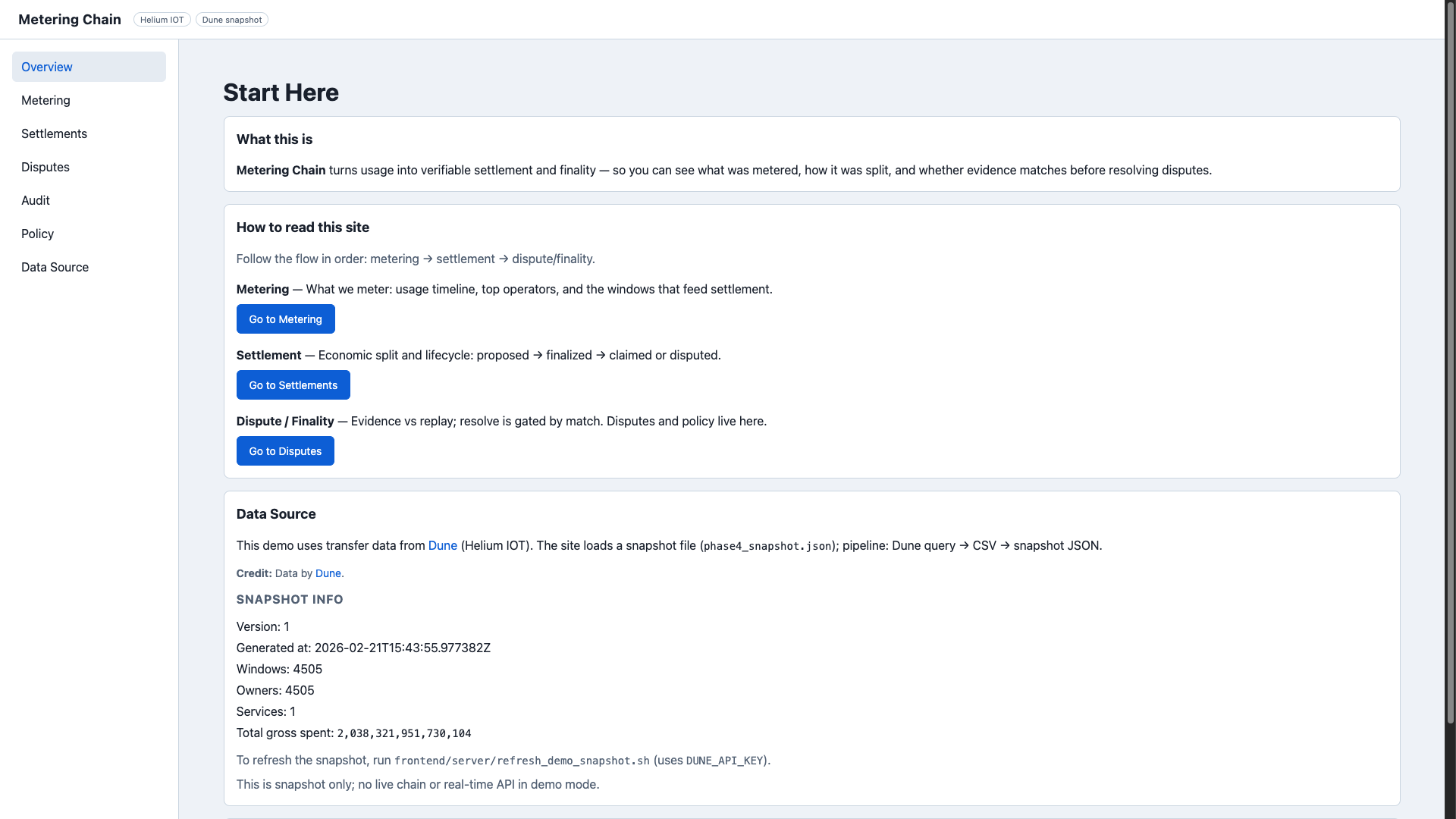
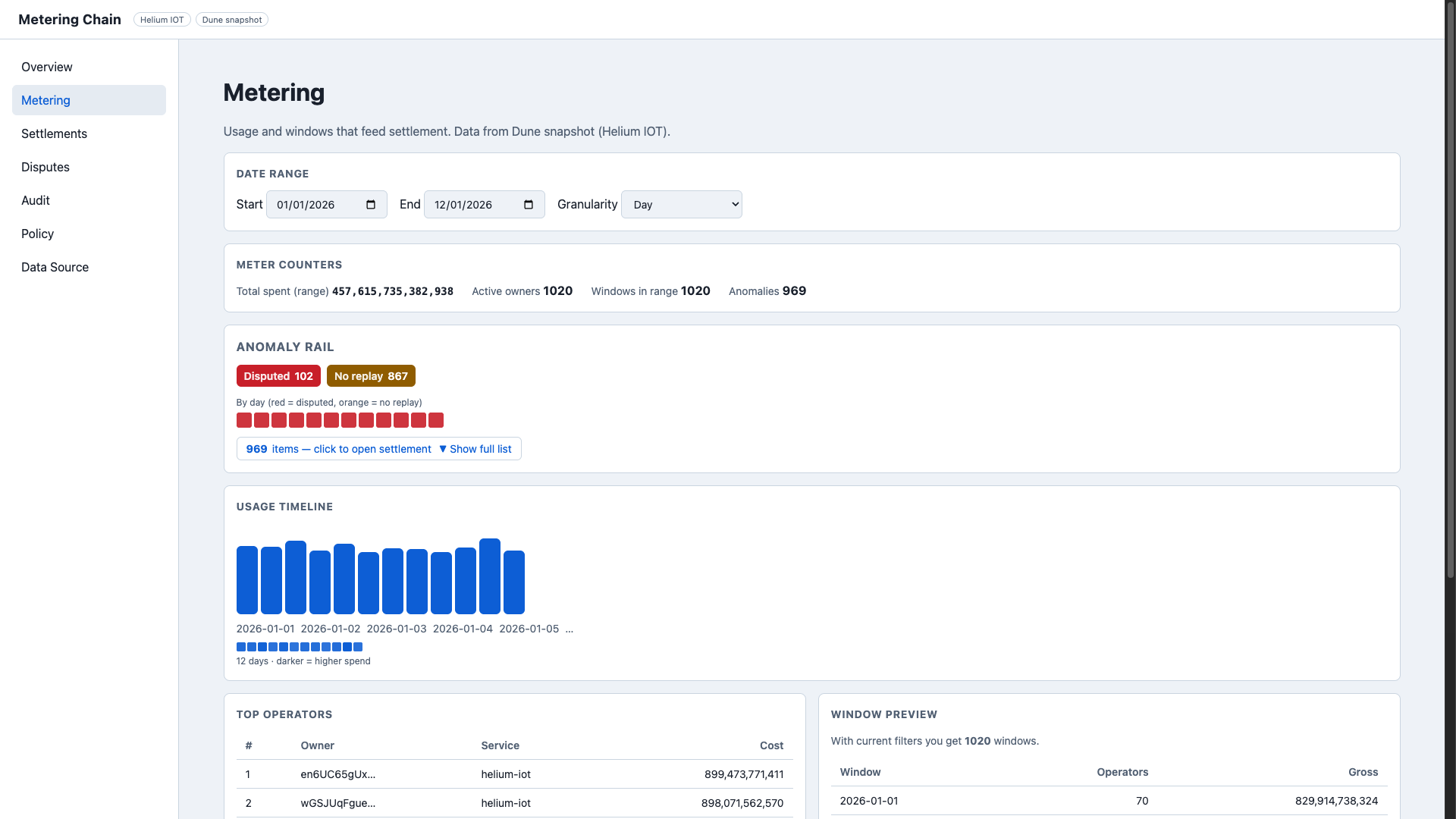
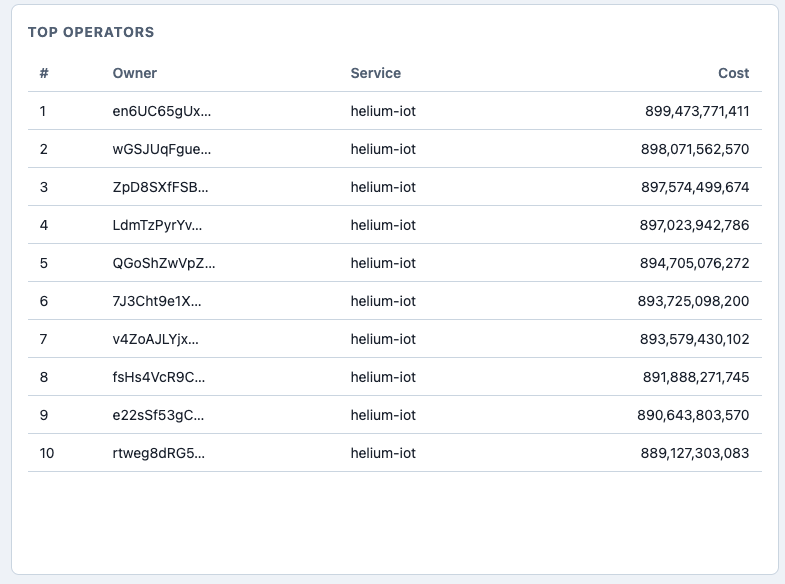
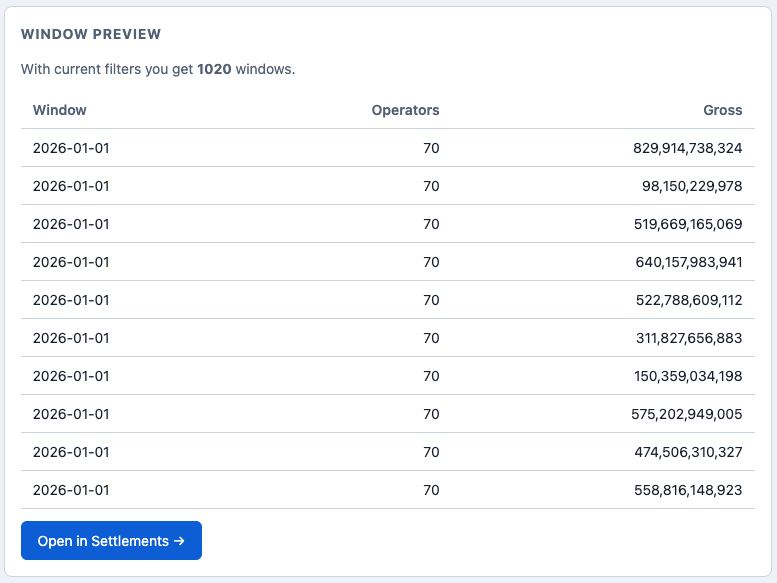
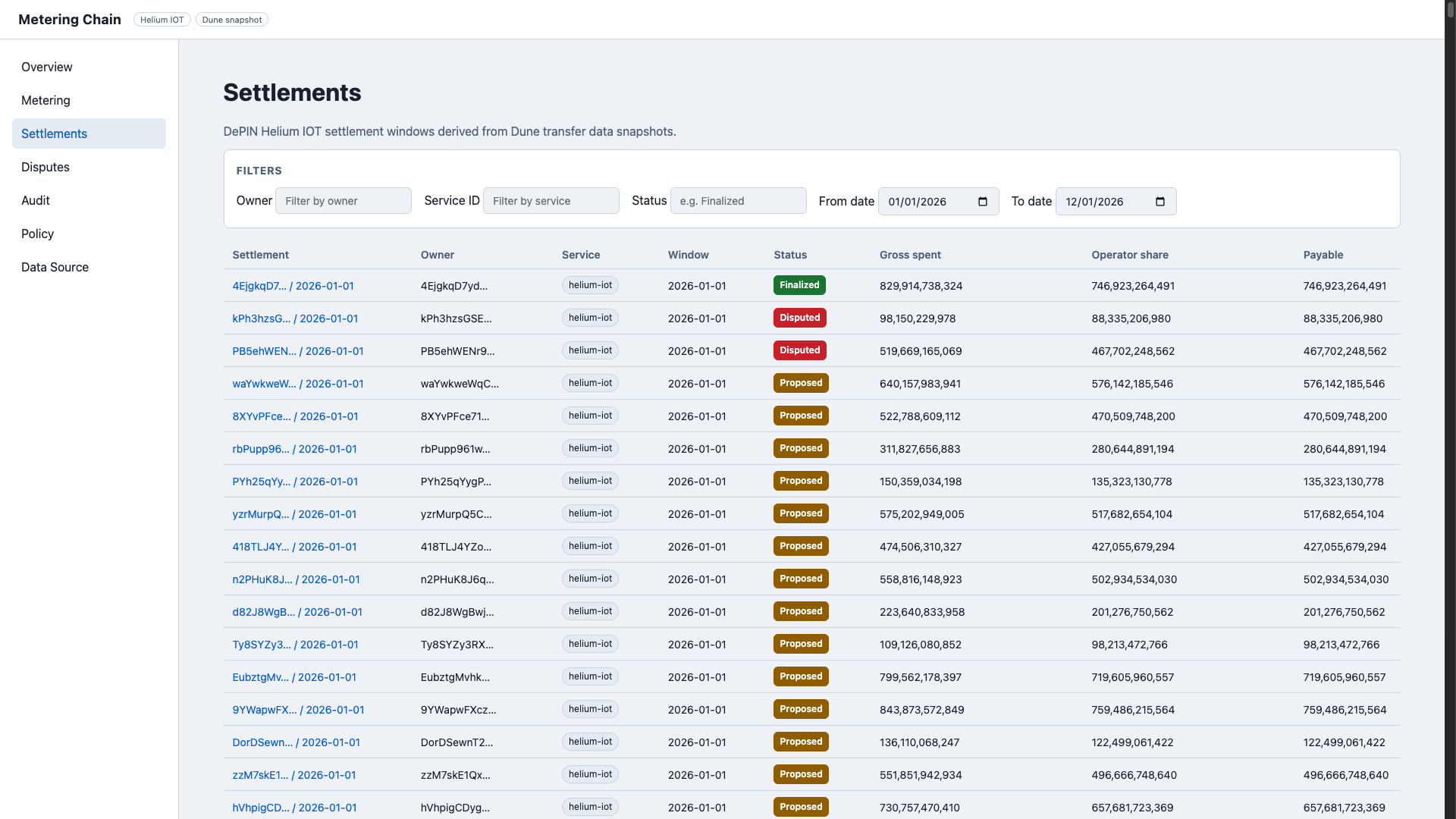
The demo site runs the same flow. These screenshots show the full closing loop: data is metered, transformed into settlement windows, and then constrained by replay/evidence gates before finality.
1. Overview (Start Here)
2. Metering main view
3. Top operators
4. Window preview
5. Settlements list
6. Settlement detail
7. Explorer with evidence gate
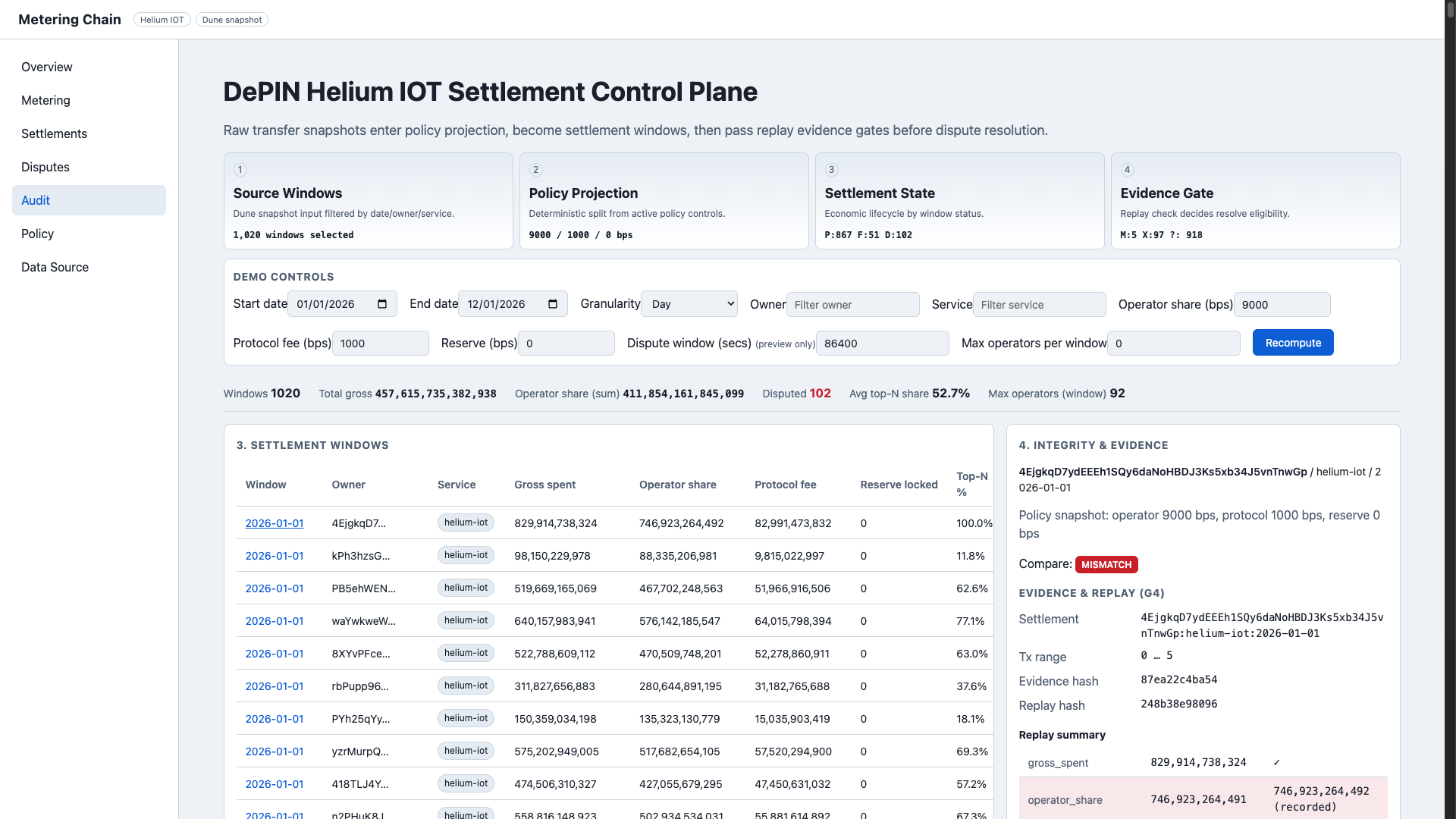
8. Audit output and rule summary
Examples (CLI: propose → finalize → claim → pay)
Like Phase 2 and Phase 3, Phase 4 is runnable from the repo. From the metering-chain README:
# From repo root
cargo run --example settlement_demo
The example runs Mint → OpenMeter → Consume, then ProposeSettlement → FinalizeSettlement → SubmitClaim → PayClaim (in-memory; for persistent state use the binary with init and apply). For disputes, policy, and evidence-backed resolve use the CLI settlement/dispute/policy flows or the frontend. Same sequence replayed from tx.log yields the same state; over-claim or double-settlement attempts get explicit error codes (e.g. CLAIM_AMOUNT_EXCEEDS_PAYABLE, DUPLICATE_SETTLEMENT_WINDOW).
CLI run
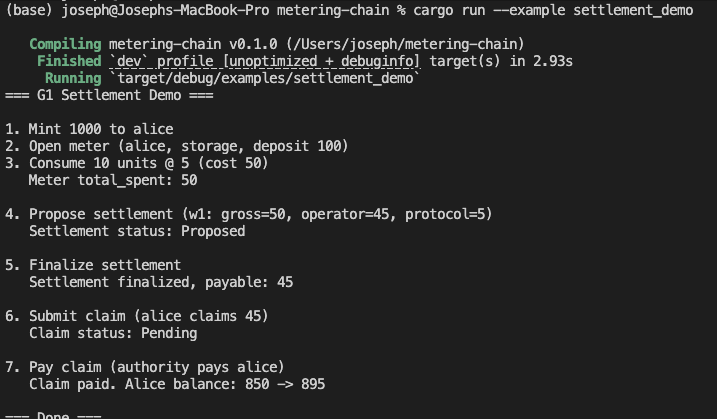
cargo run --example settlement_demo: Mint → OpenMeter → Consume → Propose → Finalize → SubmitClaim → PayClaim.
What “finality” means here (and what it does not)
In v1:
- Replaying the same tx log yields identical settlement and dispute outcomes.
- Payout safety is enforced by domain invariants.
- Every reject maps to an explicit error code.
- Evidence artifacts are queryable for audit.
Not in scope for v1:
- No multi-node consensus protocol.
- No oracle truth for physical-world events.
- No full on-chain settlement execution engine.
Phase 4 finality is single-node replayable finality, aligned with the current architecture.
Why this matters for real systems
In DePIN, API billing, or compute marketplaces, trust often breaks at payout boundaries. The technical win of Phase 4 is not a new screen or command; it is making payout decisions reproducible, challengeable, and explainable from evidence. The point is: three weeks later, we can replay the same tx slice and get the same number - or refuse to pay with a deterministic reason.
Summary
| Phase | Question answered |
|---|---|
| 1 | How is usage accounted? |
| 2 | Who can submit transactions? |
| 3 | Who can act on behalf of another? |
| 4 | How does accepted usage become settled, disputable, and final? |
Phase 4 is where Metering Chain stops being only a transaction validator and becomes a replayable economic system: same log, same settlement and dispute results, and evidence-backed resolution.
Repo: egpivo/metering-chain. CLI: cargo run --example settlement_demo. Demo site: egpivo.github.io/metering-chain — Overview → Metering → Settlements → Disputes (optional: /demo/phase4 advanced explorer).
Quick term notes
- Settlement window: billing interval keyed by
(owner, service_id, window_id). - Bound policy: policy snapshot attached at propose time; later checks do not read latest config.
- Replay summary: deterministic replay output for a tx slice (
from_tx_id,to_tx_id, totals). apply_with_replay_verifier: required entry point forResolveDispute; blocks apply on evidence/replay mismatch.