Ethereum Account State: QA Pipeline for a Minimal Token

The previous post walked through an end-to-end implementation: a minimal token contract, off-chain state reconstruction, and a React frontend — all the way from mint() to MetaMask. This post picks up where that left off: how do you QA something like this?
I’m not a blockchain engineer (yet) — but QA patterns port well across domains, and borrowing what already works elsewhere is how I learn fastest.
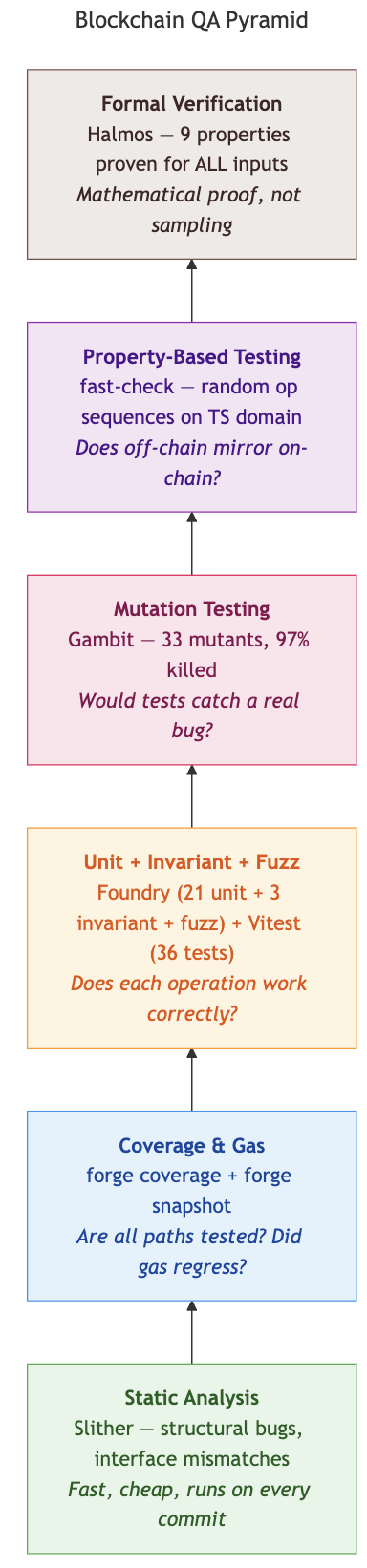
The contract only does three things — mint, transfer, and burn — but even that is enough to practice the full QA toolchain: static analysis, mutation testing, gas profiling, formal verification.
The code is in egpivo/ethereum-account-state.
What we started with
Before adding anything new, the project already had:
- 21 Foundry unit tests covering each state transition (success, revert on illegal input, event emission)
- 3 invariant tests via a
TokenHandlerthat runs random sequences ofmint/transfer/burnon 10 actors (128k calls each) - Fuzz tests checking
sum(balances) == totalSupplyfor random amounts - TypeScript domain tests (Vitest) mirroring the on-chain state machine
- CI: compile, test, lint (Prettier + solhint)
All tests passed. Coverage looked fine. So why bother with more?
Because “all tests pass” does not mean “all bugs are caught.” 100% line coverage can still miss a real bug if no assertion checks the right thing.
Phase 1: Smart contract static analysis and coverage
Slither
Slither (Trail of Bits) catches issues that are invisible to tests: reentrancy, unchecked return values, interface mismatches.
./scripts/run-qa.sh slither
Result: 1 Medium finding — erc20-interface: transfer() doesn’t return bool.
This is expected. The contract is intentionally not a full ERC20 — it is an educational state machine. But the finding is not academic: USDT’s transfer() famously does not return bool either, and that non-compliance has caused real integration failures in DeFi protocols that assumed standard ERC20 behavior. If someone later imports this token into a protocol expecting ERC20, the interface mismatch would silently fail. Slither flags it now so the decision is conscious.
Coverage
./scripts/run-qa.sh coverage
| Metric | Token.sol |
|---|---|
| Lines | 96.15% (50/52) |
| Statements | 93.10% (54/58) |
| Branches | 100% (7/7) |
| Functions | 91.67% (11/12) |
One uncovered function: BalanceLib.gt(). We will come back to this.
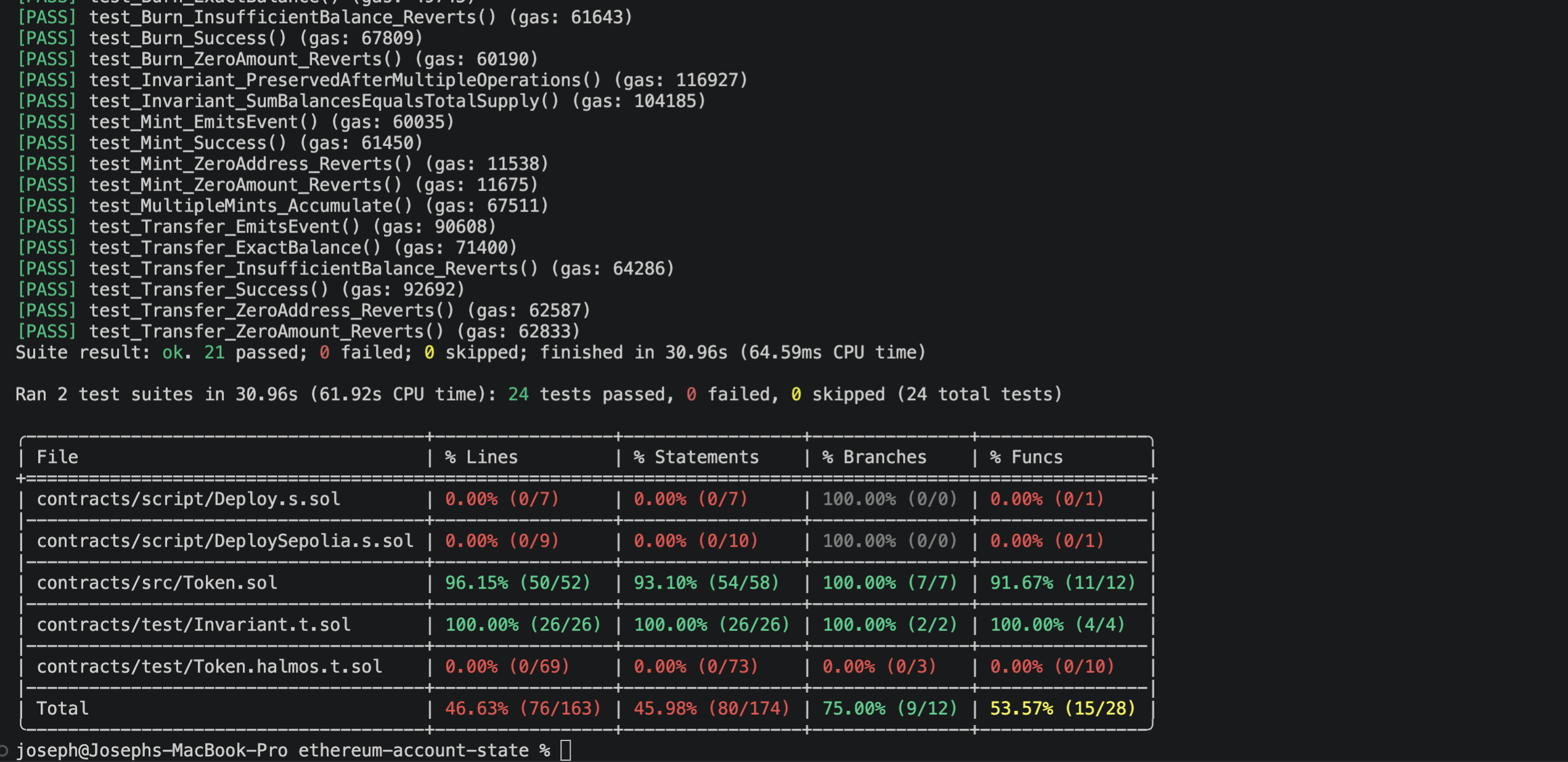
forge coverage output: 24 tests passed, Token.sol at 96% lines / 100% branches / 91.67% functions.
Gas snapshots
./scripts/run-qa.sh gas
Baseline gas costs for the three operations:
| Operation | Gas |
|---|---|
mint |
~59k |
transfer |
~88k |
burn |
~64k |
On subsequent runs, forge snapshot --diff compares against the baseline. A 20% gas regression in transfer() is a real cost to every user — catching it before merge is cheap.
Phase 2: Mutation testing and formal verification
Mutation testing (Gambit)
This is where things got interesting. Gambit (Certora) generates mutants — copies of Token.sol with small deliberate bugs (+= to -=, >= to >, conditions negated). The pipeline runs the full test suite against each mutant. If a mutant survives (all tests still pass), that is a concrete test gap.
./scripts/run-qa.sh mutation
Result: 97.0% mutation score — 32 killed, 1 survived out of 33 mutants.
Gambit’s output log shows each mutant and what it changed. A few examples:
Generated mutant #7: BinaryOpMutation — Token.sol:168
  totalSupply = totalSupply.add(amountBalance)  →  totalSupply = totalSupply.sub(amountBalance)
  KILLED by test_Mint_Success

Generated mutant #19: RelationalOpMutation — Token.sol:196
  if (!fromBalance.gte(amountBalance))  →  if (fromBalance.gte(amountBalance))
  KILLED by test_Transfer_Success

Generated mutant #28: SwapArgumentsMutation — Token.sol:81
  return Balance.unwrap(a) > Balance.unwrap(b)  →  return Balance.unwrap(b) > Balance.unwrap(a)
  SURVIVED ← no test caught this
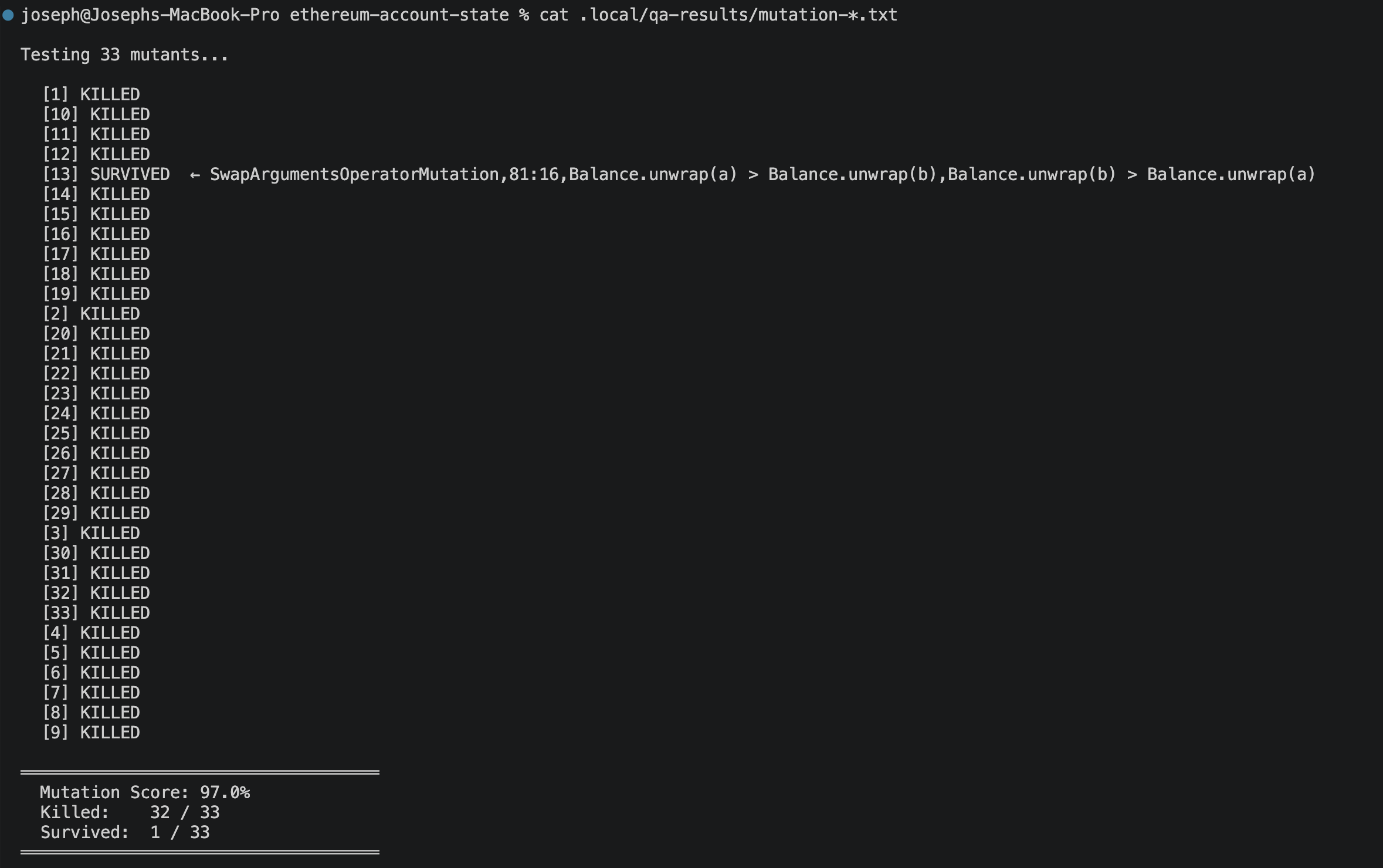
[13] SwapArgumentsOperatorMutation on BalanceLib.gt().
The surviving mutant swapped a > b to b > a in BalanceLib.gt(). No test caught it — because gt() is dead code. It is never called anywhere in Token.sol.
Coverage flagged 91.67% functions but could not explain the gap. Mutation testing did: gt() is dead code, nothing calls it, and nobody would notice if it were wrong.
Dead or unprotected code in smart contracts has real precedent. In 2017, an unprotected initWallet() function in the Parity multisig library was called by an outside user, who then triggered kill() — permanently freezing over $150M across 500+ wallets. The function was not intended to be callable, but nobody tested that assumption. Our gt() is harmless by comparison, but the pattern is the same: code that exists but is never exercised is code that nobody is watching.
Formal verification (Halmos)
Halmos (a16z) reasons about all possible inputs symbolically. Where fuzz tests sample random values and hope to hit edge cases, Halmos proves properties exhaustively.
./scripts/run-qa.sh halmos
Result: 9/9 symbolic tests pass — all properties proven for all inputs.
Properties verified:
| Property | Result |
|---|---|
mint increases totalSupply by exactly amount |
Proven |
mint increases recipient balance by exactly amount |
Proven |
transfer preserves totalSupply |
Proven |
burn decreases totalSupply by exactly amount |
Proven |
mint(address(0), ...) always reverts |
Proven |
mint(..., 0) always reverts |
Proven |
transfer with insufficient balance always reverts |
Proven |
BalanceLib.add — no overflow (within uint128) |
Proven |
BalanceLib.sub — correct when a >= b |
Proven |
One practical note: Halmos 0.3.3 does not support vm.expectRevert(), so I could not write revert tests the normal Foundry way. The workaround is a try/catch pattern — if the call succeeds when it should revert, assert(false) fails the proof:
function check_mint_reverts_on_zero_address(uint256 amount) public {
    vm.assume(amount > 0);
    try token.mint(address(0), amount) {
        assert(false); // should not reach here
    } catch {
        // expected revert — Halmos proves this path is always taken
    }
}
Not the prettiest, but it works — Halmos still proves the property for all inputs. This is the kind of thing you only find out by actually running the tool.
For context on why formal verification matters: the 2016 DAO hack exploited a reentrancy pattern that drained ~$60M and led to Ethereum’s hard fork. The vulnerability was in the code, reviewable by anyone, but no tool or test caught it before deployment. Symbolic provers like Halmos exist precisely to close that gap — they do not sample; they exhaust the input space.

The test file is contracts/test/Token.halmos.t.sol.
Phase 3: Cross-layer property testing
The first post’s architecture has a TypeScript domain layer that mirrors the on-chain state machine. This phase tests whether the two actually agree.
Property-based testing with fast-check
I added fast-check property tests for the TypeScript domain layer, mirroring what Foundry’s fuzzer does for Solidity:
npm test -- tests/unit/property.test.ts
Result: 9/9 property tests pass — after fixing a real bug.
Properties tested:
Balance: commutativity, associativity, identity, inverse, comparison consistencyToken: invariantsum(balances) == totalSupplyunder random operation sequences (200 runs, 50 ops each)Token:totalSupplynon-negative after random sequencesmintalways succeeds for valid inputstransferpreservestotalSupply
The bug fast-check found
fast-check found a real cross-layer consistency bug in Token.ts transfer(). The shrunk counterexample was immediately clear:
Property failed after 3 tests
Shrunk 2 time(s)
Counterexample: transfer(from=0xaaa..., to=0xaaa..., amount=1n)
  → from == to (self-transfer)
  → verifyInvariant() returned false
Self-transfer (from == to) broke the sum(balances) == totalSupply invariant. toBalance was read before fromBalance was updated, so when from == to, the stale value overwrote the deduction:
// Before (buggy)
const fromBalance = this.getBalance(from);
const toBalance = this.getBalance(to);      // ← stale when from == to

this.accounts.set(from.getValue(), fromBalance.subtract(amount));
this.accounts.set(to.getValue(), toBalance.add(amount));  // ← overwrites the subtraction
Fix: read toBalance after writing fromBalance, matching Solidity’s storage semantics:
// After (fixed)
const fromBalance = this.getBalance(from);
this.accounts.set(from.getValue(), fromBalance.subtract(amount));

const toBalance = this.getBalance(to);      // ← now reads updated value
this.accounts.set(to.getValue(), toBalance.add(amount));
The Solidity contract was not affected — it re-reads storage after each write. But the TypeScript mirror had a subtle ordering dependency that no existing unit test covered.
Cross-layer mismatches at larger scale have been catastrophic. The 2022 Wormhole bridge hack ($320M) exploited a gap between off-chain guardian validation and on-chain verification — the two layers disagreed on what constituted a valid signature, and the attacker walked through the gap. Our self-transfer bug would not have lost anyone money, but the failure mode is structurally the same: two layers that are supposed to agree, don’t.
Pitfalls hit along the way
Running QA tools on an existing project is never just “install and run.” A few things broke before they worked:
- 0% coverage because
foundry.tomlhad no test path: The firstforge coveragerun returned 0% across the board. Turns outfoundry.tomldid not specifytest = "contracts/test"orscript = "contracts/script", so Forge was not discovering any tests. The coverage command succeeded silently — it just had nothing to cover. This was the most misleading failure: a green run with no useful output. InvariantTestimport gone in forge-std v1.14.0:Invariant.t.solimportedInvariantTestfromforge-std, which was removed in a recent release. Compilation failed with an opaque “symbol not found” error. The fix was to drop the import —Testalone is sufficient for Foundry’s invariant testing now.uint256(token.totalSupply())vsBalance.unwrap(): Tests were using an explicit cast to extract the underlyinguint256from the user-definedBalancetype. It compiled, but it is the wrong idiom —Balance.unwrap(token.totalSupply())is what the UDVT system is designed for. Applied acrossToken.t.sol,Invariant.t.sol, andDeploySepolia.s.sol.
Pipeline design
Everything runs through two scripts:
scripts/setup-qa-tools.sh— installs Slither, Halmos, Gambit (idempotent)scripts/run-qa.sh— runs checks, saves timestamped results to.local/qa-results/
./scripts/run-qa.sh slither gas        # just static analysis + gas
./scripts/run-qa.sh mutation           # just mutation testing
./scripts/run-qa.sh all                # everything
Not every check is fast. Slither and coverage run on every commit. Mutation testing and Halmos are slower — better suited for weekly or pre-release runs.
Summary
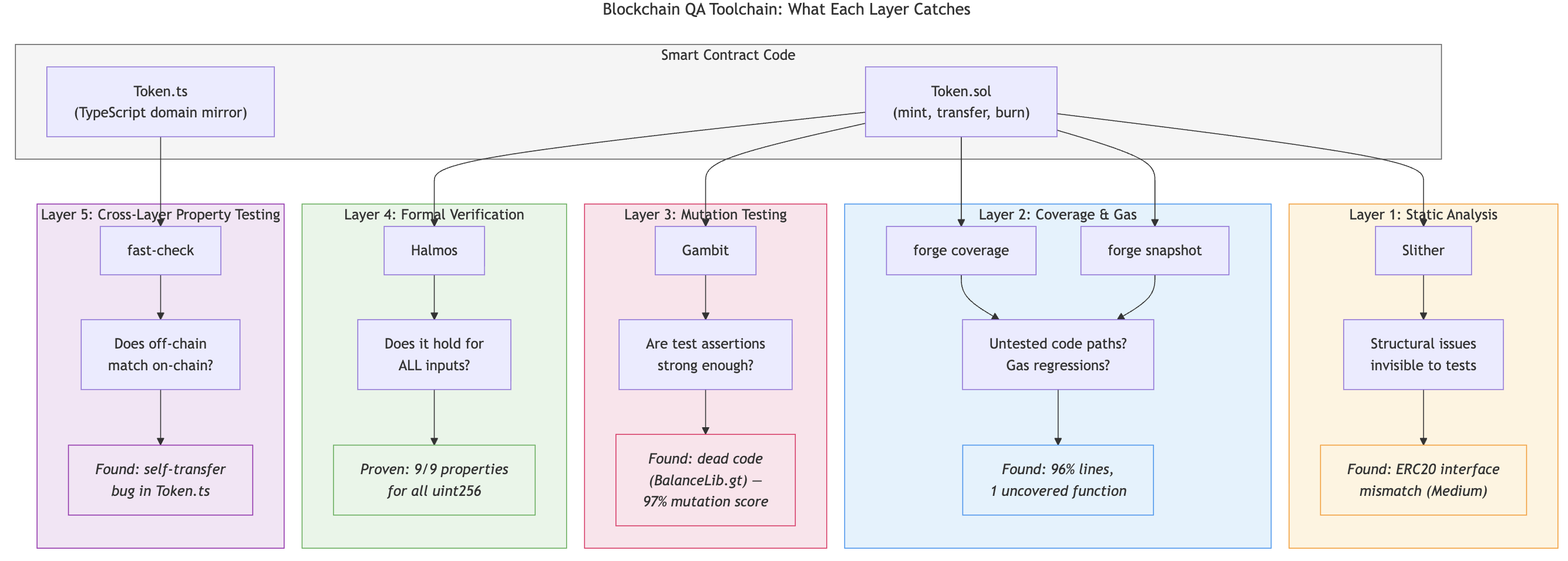
| Layer | Question answered | What we found |
|---|---|---|
| Static analysis (Slither) | Structural vulnerabilities tests can’t see? | 1 Medium: transfer() missing ERC20 bool return (intentional) |
| Coverage (Forge) | Code paths no test reaches? | 96% lines, 100% branches, 1 uncovered function |
| Gas snapshots | Did a refactor regress gas? | Baseline: mint ~59k, transfer ~88k, burn ~64k |
| Mutation testing (Gambit) | Are assertions strong enough? | 97% score — 1 survivor = dead code (BalanceLib.gt()) |
| Formal verification (Halmos) | Does it hold for all inputs? | 9/9 properties proven |
| Property testing (fast-check) | Does off-chain match on-chain? | Found self-transfer bug in Token.ts |
Gambit and fast-check gave the most actionable results in this round.
CI pipeline
The QA checks are now wired into GitHub Actions as a six-stage pipeline:
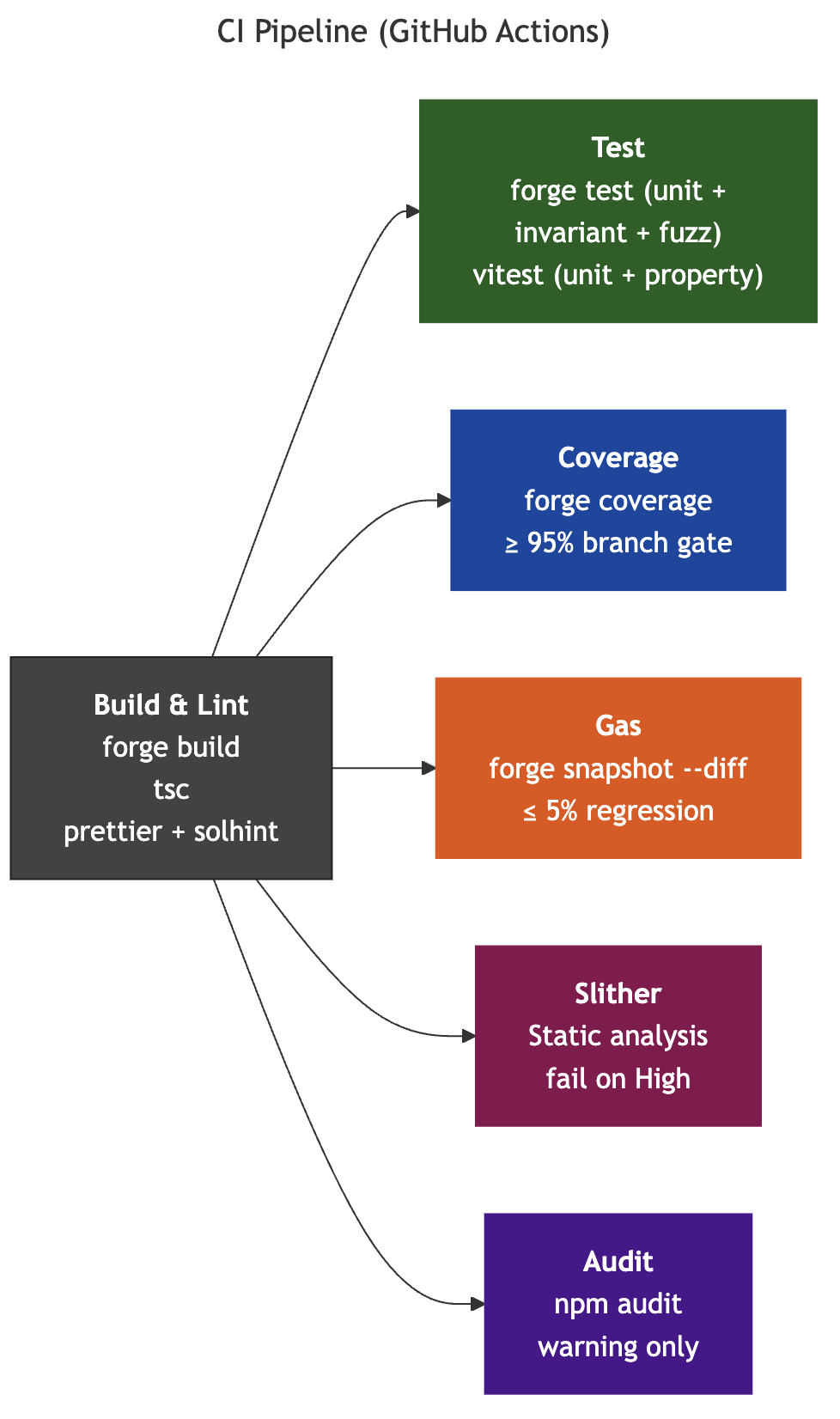
| Stage | What it does | Gate |
|---|---|---|
| Build & Lint | Compile Solidity + TypeScript, run Prettier + solhint | Fail on error |
| Test | Foundry tests (unit + invariant + fuzz) + Vitest (unit + property) | Fail on error |
| Coverage | forge coverage + LCOV, check Token.sol branch coverage |
Fail if < 95% |
| Gas | forge snapshot --diff --tolerance 5 against baseline |
Fail if > 5% regression |
| Slither | Static analysis, --fail-on high |
Fail on High findings |
| Audit | npm audit --audit-level=high |
Warning only |
Mutation testing and Halmos are not in CI yet — they are slower and better suited for pre-release runs.
References
- Ethereum Account State source: github.com/egpivo/ethereum-account-state
- Previous post: Ethereum Account State
- Slither: github.com/crytic/slither
- Gambit: github.com/Certora/gambit
- Halmos: github.com/a16z/halmos
- fast-check: github.com/dubzzz/fast-check
- Foundry: getfoundry.sh