Where RWA Exchange Risk Actually Sits
When the venue becomes part of the product, which record is authoritative?
When SpaceX listed on Nasdaq as SPCX in June 2026, crypto users met several versions at once: Binance Wallet SPCXx, Bybit IPO Express, Backpack SPCX on Solana, and SPCXUSDT pre-IPO perps. The names were similar, but the products created different claims and records.
RWA venues do not trade one asset record. They trade claims whose authority sits in different record systems.
The break occurred at the allocation layer. Crypto venues could collect subscriptions, lock USDC, and define refund terms. They did not control whether the upstream provider received shares or could deliver the corresponding tokenized product. When that step failed, the venue could return funds or issue compensation, but it could not turn the original subscription into an allocation.
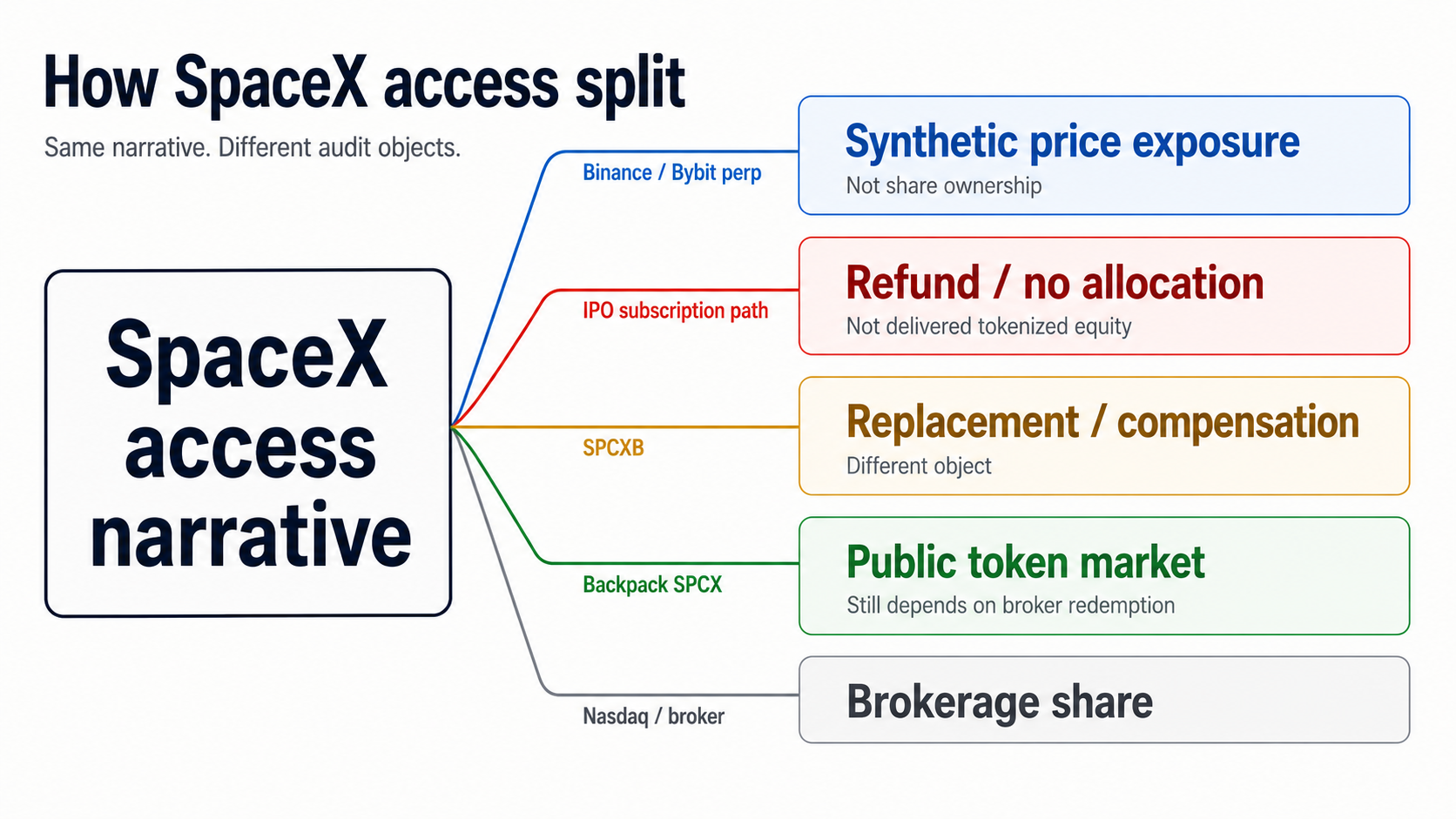
This is Part III of the RWA audit series. Part I examined the asset layer. Part II traced trades and exits across pools, quote routes, platform ledgers, and issuer workflows. This post focuses on the exchange layer, where the venue can turn the same underlying exposure into a derivative position, subscription balance, collateral entry, routed token transfer, or redemption claim.
SpaceX access split into multiple records
- Pre-IPO perp (
SPCXUSDT, Binance / Bybit) → synthetic price exposure - SPCXx campaign (Binance Wallet, Bybit IPO Express) → subscription / allocation claim
- SPCXB (Binance bStocks) → replacement platform token
- Nasdaq SPCX → brokerage share
- Backpack SPCX (Solana) → wallet token + broker redemption stack
- xStocks SPCXx (if delivered) → tracker certificate
Do not collapse tickers.
Nasdaq SPCX
≠ xStocks SPCXx
≠ Binance SPCXB
≠ Backpack Solana SPCX
(SPCXxcqXj6e5dJDVNovHN8744zkbhM2bYudU45BimGb)
≠ SPCXUSDT perp.
Pre-IPO derivatives
Binance offered SPCXUSDT pre-IPO perps before listing day. Binance’s announcement states they do not represent ownership of the underlying share. Bybit listed SpaceX-linked SPCXUSDT pre-IPO perps per its announcement in the same product class: margin and index exposure, not allocation or redemption.
I looked at the pre-IPO perp tape separately in an earlier note. Here, the perp is only one branch of the broader exchange-layer object split.
CEX subscription and allocation claims
Bybit IPO Express opened June 7 to 11, 2026 with xStocks as tokenization partner per Bybit’s launch announcement. Funds locked until allocation; unused balance refunded. Campaign materials described pro rata allocation, not a guaranteed fill. Binance’s Wallet SPCXx page used the same shape: locked USDC, distribution not guaranteed.
On IPO day both campaigns broke at allocation / delivery, not subscription intake. Bybit’s update reported zero allocations and full refunds when xStocks could not deliver. Binance canceled SPCXx, refunded USDC, and airdropped SPCXB. The airdrop was $1M split by June 18 on a different ticker.
The intended chain was:
CEX subscription balance → provider allocation request → broker inventory or share allocation → legal issuance → token delivery → redemption availability
The public evidence places the break after subscription intake and before token delivery. It does not locate the exact failed link inside that interval.
The public announcements identify the failed step, but not the full upstream cause. They do not show whether the constraint was share allocation, broker inventory, custody readiness, legal issuance, or another delivery dependency. The refund records confirm that the venues could reverse customer balances. They do not show that the venues or their provider had secured the asset needed to complete the original product.
The subscription interface worked. The record chain did not.
This also raises a question for the next layer of the audit. Binance could refund USDC and distribute a replacement token because it controlled the customer ledger and knew the affected participant set. What if the same failure occurred after subscriptions had moved through contracts, pools, or multiple wallets?
My conjecture is not that a decentralized system cannot repair the failure. It is that repair would depend on mechanisms defined before the failure: a refund path, participant snapshot, pause authority, upgrade key, governance process, or funded compensation contract. Without one of those paths, public settlement may make the failed state easier to inspect while making coordinated remediation slower and more contested. The next post will examine that DEX-side problem directly.
Backpack / Sunrise Solana path
CoinDesk reported a same-day Solana launch with broker redemption through Backpack’s stack. The mint and Jupiter token page show that the token existed and could be surfaced for swaps. Those records do not establish who held the corresponding shares, when redemption was available, or which broker record controlled the conversion. The on-chain leg makes transfer and routing easier to inspect. The share entitlement still depends on the brokerage stack described off-chain.
Issuer legal wrapper (xStocks family)
xStocks official docs: each xStock is a tracker certificate with economic exposure; no voting rights; not direct equity ownership. IPO-access products on xStocks inherit that object unless a separate prospectus says otherwise.
General framework: what RWAs become inside venues
Inside a venue, an RWA can become a platform balance, collateral input, routed transfer, or redemption claim. Each form fails differently because a different system decides whether the user can trade, withdraw, pledge, or redeem.
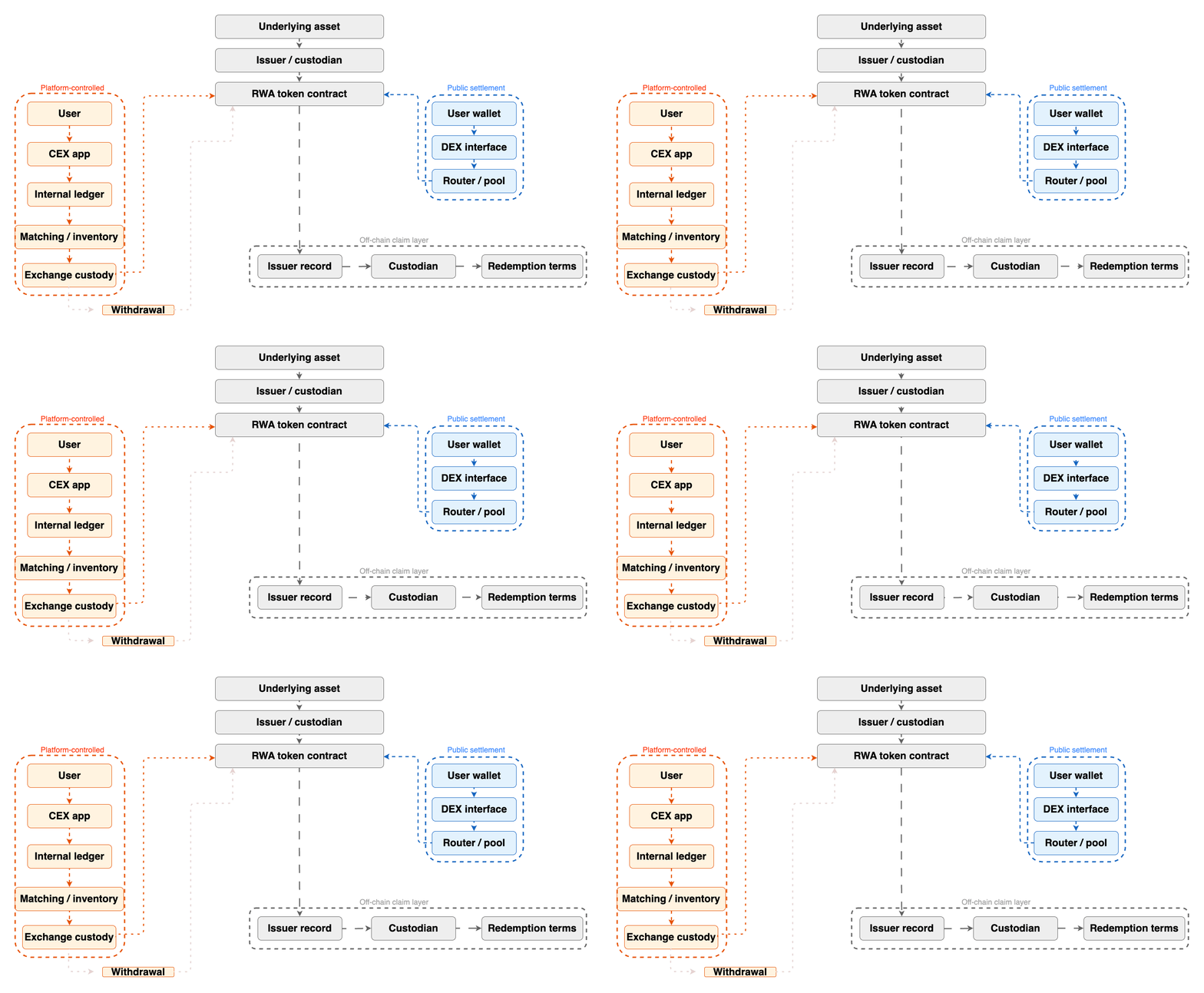
The interface can therefore succeed while a later step fails. A returned quote may disappear at a larger size, and a platform balance can update without public settlement. Even a completed token transfer leaves the separate redemption process unresolved.
Three recurring venue functions
The cases below are not direct analogues. They show how the controlling record changes with the venue function.
A. Kraken / xStocks: platform-record trading path
xStocks-family tracker certificates on Kraken look like a normal exchange product: ticker, balance, fill. The fill first changes Kraken’s customer ledger. It does not create a public token transfer for each trade.
This creates a three-record reconciliation problem. Kraken records the customer liability in its platform ledger; its general Proof of Reserves program is a separate proof surface. The xStocks issuer reserve proof addresses the assets backing the certificate structure, while the product terms govern withdrawal and redemption. None of those records alone maps one customer’s platform balance through the full custody and issuer chain. A failure can sit in platform accounting, withdrawal processing, issuer reserves, or redemption terms even when the trading screen continues to show a balance.
B. OKX / BUIDL: collateral / risk-engine input
BUIDL is a tokenized money-market fund interest for qualified investors. Under the April 2026 framework announced by OKX, BlackRock, and Standard Chartered, eligible clients can pledge BUIDL as yield-bearing collateral while Standard Chartered provides off-exchange custody.
Here, token ownership is only an input. OKX’s risk engine must decide whether the position counts as collateral, what value to recognize, and when liquidation can occur. A public transfer can show that BUIDL moved to a custodian or approved address. It cannot show the collateral value recognized by OKX or the conditions under which the position will be released or liquidated. The relevant audit risk is a mismatch between custody state and risk-engine state, not insufficient AMM liquidity.
C. Jupiter / xStocks: aggregator-mediated public settlement path
A Jupiter quote exposes more of the execution path than a CEX fill because the response can identify route legs and expected output. It is still only a quote. The route may change before execution, price impact can expand with size, and a successful swap says nothing about issuer redemption.
The June samples reviewed here were quote-level and mint-metadata-level evidence, not executed transaction proof. They are useful for checking route composition, token controls, and price impact at the sampled size. They cannot establish durable exit capacity or make one pool the default xStocks market. This is the DEX-side failure mode: public execution evidence is available, but liquidity can fragment across routes while the legal exit remains outside the swap.
Metrics are not interchangeable
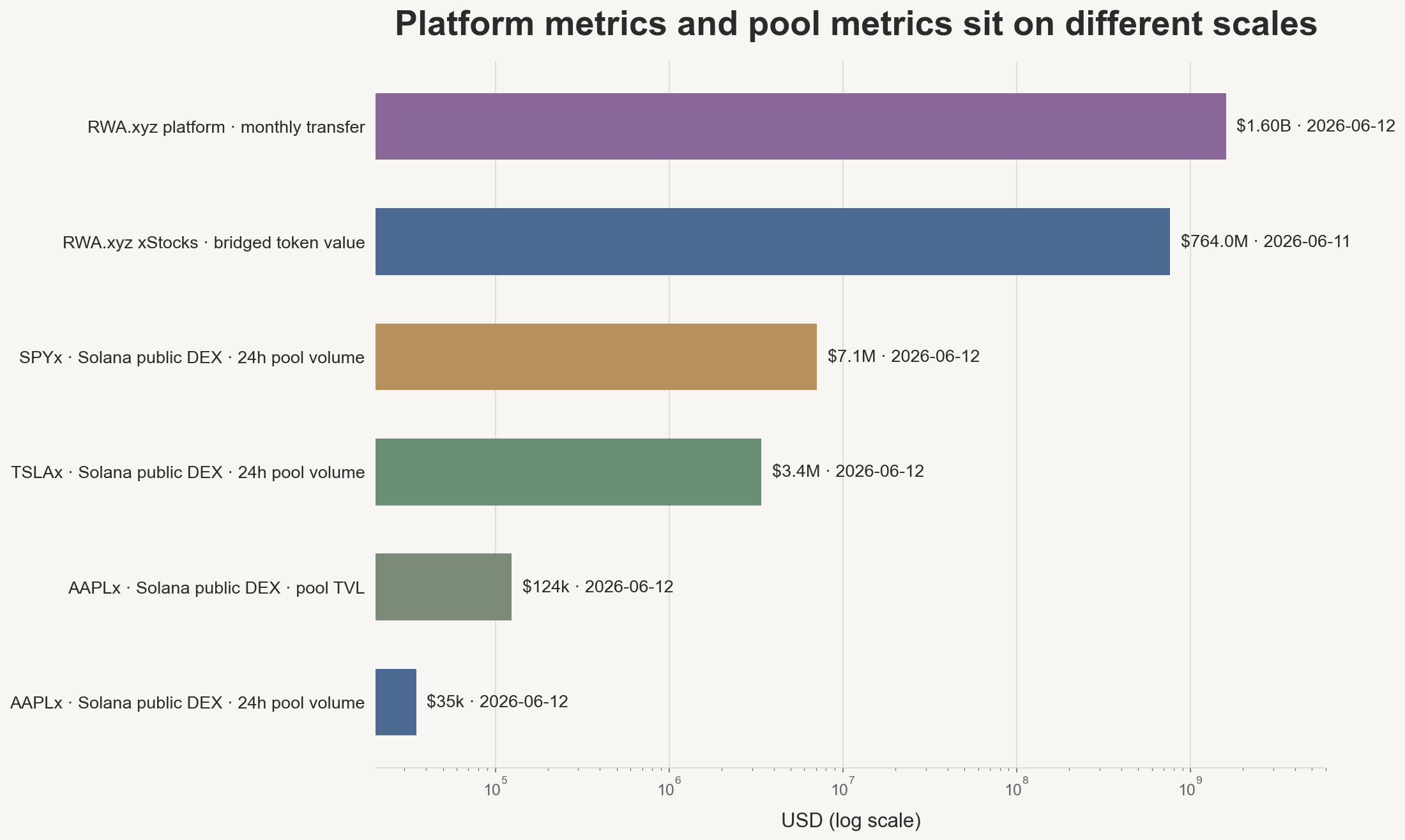
Fig. 3 puts several xStocks measurements beside each other because they are easy to confuse:
- RWA.xyz platform transfer (~$1.03B April / $1.60B June 2026 on the xStocks platform page; author captures): wallet-to-wallet transfers on-chain in USD, not CEX trading volume.
- Bridged / distributed value (~$764M in Fig. 3, June 11, 2026; author-captured): platform-scale stock metric, not transfer flow.
- Solana DEX pool TVL / volume (AAPLx ~$124k / ~$35k 24h, author-captured GeckoTerminal snapshot June 12, 2026): public pool snapshot, not an IPO book.
- Jupiter quote (author-captured AAPLx at $100k USDC, June 2026, ~68% price impact): one size, not exit capacity.
- Platform refund records returned funds after a failed delivery path.
Closing
RWA exchange is structurally multi-record. The trading screen, customer ledger, token contract, custodian account, issuer register, broker inventory, and redemption workflow do not become one authoritative record simply because they share a ticker.
This is not opacity by accident. Each record belongs to a different function and often a different institution. The practical question is which record controls the next state transition. For an IPO campaign, allocation and delivery records decide whether a subscription becomes an asset. For collateral, the risk engine decides what value can support a position. For an aggregator route, execution data proves the swap, while issuer terms still control redemption.
More tokenization will not necessarily reduce this fragmentation. Adding chains, bridges, aggregators, collateral systems, and automated redemption paths creates more state transitions that must agree. Composability expands access, but it also expands the reconciliation surface.
The next stage of RWA infrastructure therefore needs more than public tokens and visible transfers. It needs explicit links between records, defined authority when they disagree, and remediation paths for the point where the chain stops.
Appendix: evidence and reproduction
Evidence: egpivo/rwa-audit
- rwa_xyz_platform_transfer_snapshots.json
- rwa-token-timeseries-export CSV
- gecko_aaplx_pools.json
- gecko_tslax_pools.json
- gecko_spyx_pools.json
- jupiter_quote_aaplx_100k.json
Reproduce the data with the command
cargo run --bin rwa-exchange-freeze