Dynamic Fees in AMMs: When the Signal Matters
Part I asked whether an AMM surface formed. Part II ran pool state forward. Part III contrasted reserves with book depth. This piece runs the AMM defense layer: fixed fee vs state-responsive fee.
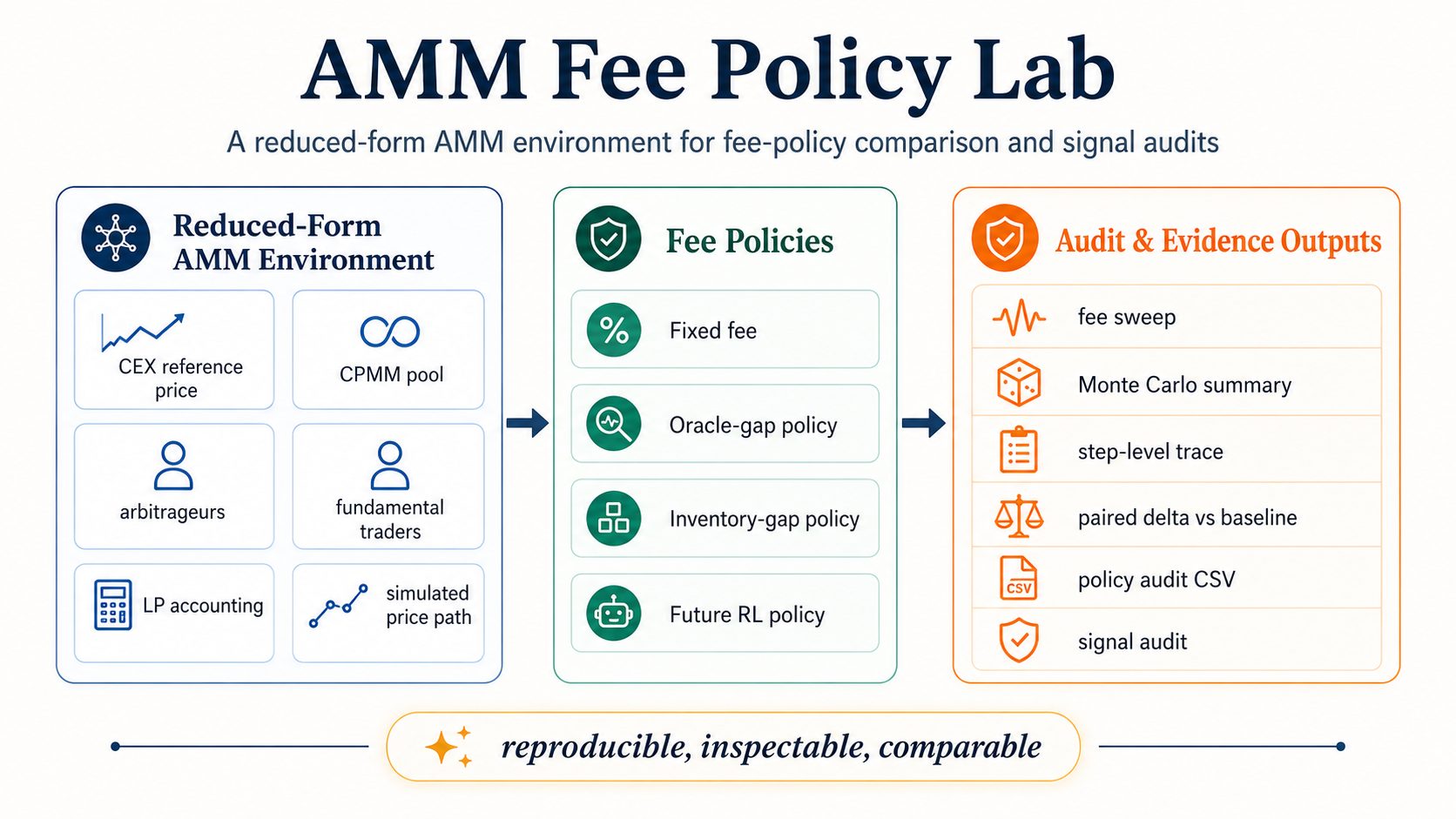
Part III ended on dynamic fees as evidence that the fixed-fee pool was under-defended—not as proof that hooks beat a book. Uniswap v4 dynamic fees make the defense layer callable: a hook can read pool state and set the fee per swap.
The design question is narrower than “can the hook observe more fields?” Under this constant-function market maker (CFMM) setup—specifically a constant-product market maker (CPMM)—does an extra field add information, or only rescale a response the invariant already implies?
I put Campbell et al. (2025) and Baggiani et al. (2025) into the same Rust lab. Campbell et al. supply the fixed-fee LP objective and the routing mechanism: when CEX trading is costly, a stale AMM can still attract fundamental flow by charging a low enough fee. Baggiani et al. supply the policy question—whether observation-based fees can beat a static optimum. Four policies share one FeePolicy interface and the same Monte Carlo paths: fixed 6 bps, fixed 10 bps, oracle-gap, and inventory-gap.
The bridge is market-making control. Campbell et al. define what the pool is trying to protect: fee revenue net of stale-price loss. Baggiani et al. change the fee from a scalar parameter into a policy over market state. A CLOB maker does this through spreads, size, cancels, and exposure limits when flow turns toxic. A programmable AMM cannot reproduce the whole book, but fee is its smallest spread-like defense.
The Campbell baseline
This is a baseline check, not a fee-design breakthrough. A CEX or oracle reference moves before the pool price does. Arbitrage closes the gap; the LP absorbs LVR. Campbell et al. formalize that setting with arbitrageurs, fundamental traders, and a passive LP. Hedged PnL is fee revenue minus tracking error.
In the lab, oracle_gap_bps is pool price vs CEX price in bps—the exposure window before arb trades. arb_delta closes the gap each step; hedged_pnl records what the LP kept net of LVR.
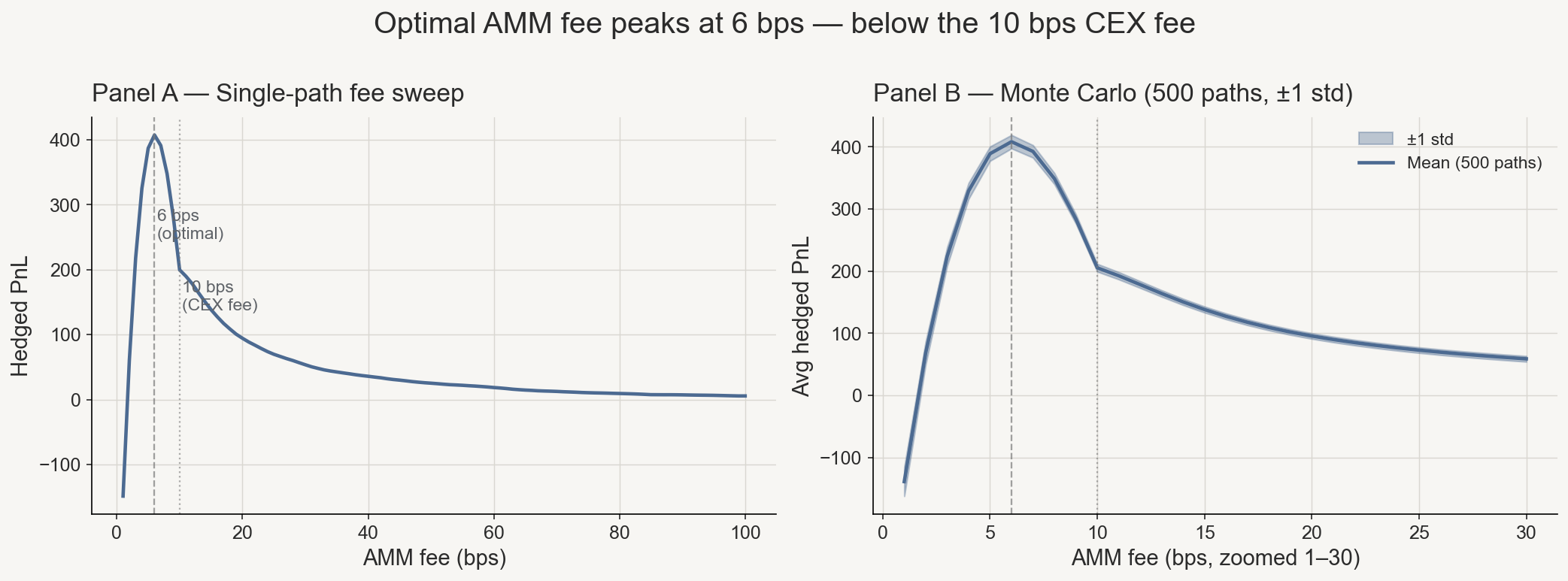
With a 10 bps CEX fee, the optimum AMM fee lands near 6 bps. Higher fees extract more per arb trade but widen the no-trade band and lose fundamental flow. I reproduced the sweep in Rust—1 to 100 bps on one GBM path, then 500-path Monte Carlo.
amm-lab.
Below 6 bps, arb keeps trading but the fee does not cover LVR. Above 6 bps, the pool keeps some arb revenue but loses fundamental flow to the CEX.
Fee as a policy
Dynamic fees are control laws over observations. Production hooks override the fee in beforeSwap or via updateDynamicLPFee. The simulation uses the same surface: observe state, choose fee, run arb and fundamental trades.
pub trait FeePolicy {
    fn name(&self) -> &'static str;
    fn fee(&mut self, obs: &FeeObservation) -> f64;
}
FeeObservation carries oracle gap (bps), inventory skew, and recent realized volatility. In this comparison, realized volatility is recorded but not used in the fee rule. Each step calls policy.fee(&obs) before trades execute.
FixedFeePolicy reproduces the Campbell baseline. In these runs, fee is stored as a fraction (1 bps = 0.0001, so base_fee = 0.0006). The two dynamic policies are:
- OracleGapFeePolicy:
fee = base_fee + 0.04 × |oracle_gap_bps| / 10 000, clamped to [1, 20] bps - InventoryGapFeePolicy:
fee = base_fee + 0.01 × |inventory_skew|, clamped to [1, 20] bps
Oracle-gap charges more when the pool has drifted from the CEX. Inventory-gap charges more when reserve composition is imbalanced. Same interface; different stated signal.
Oracle-gap beats fixed 6 bps on every path
Across 500 paired Monte Carlo paths, oracle-gap beat fixed 6 bps on every path: mean Δ hedged PnL +15.2, minimum +8.
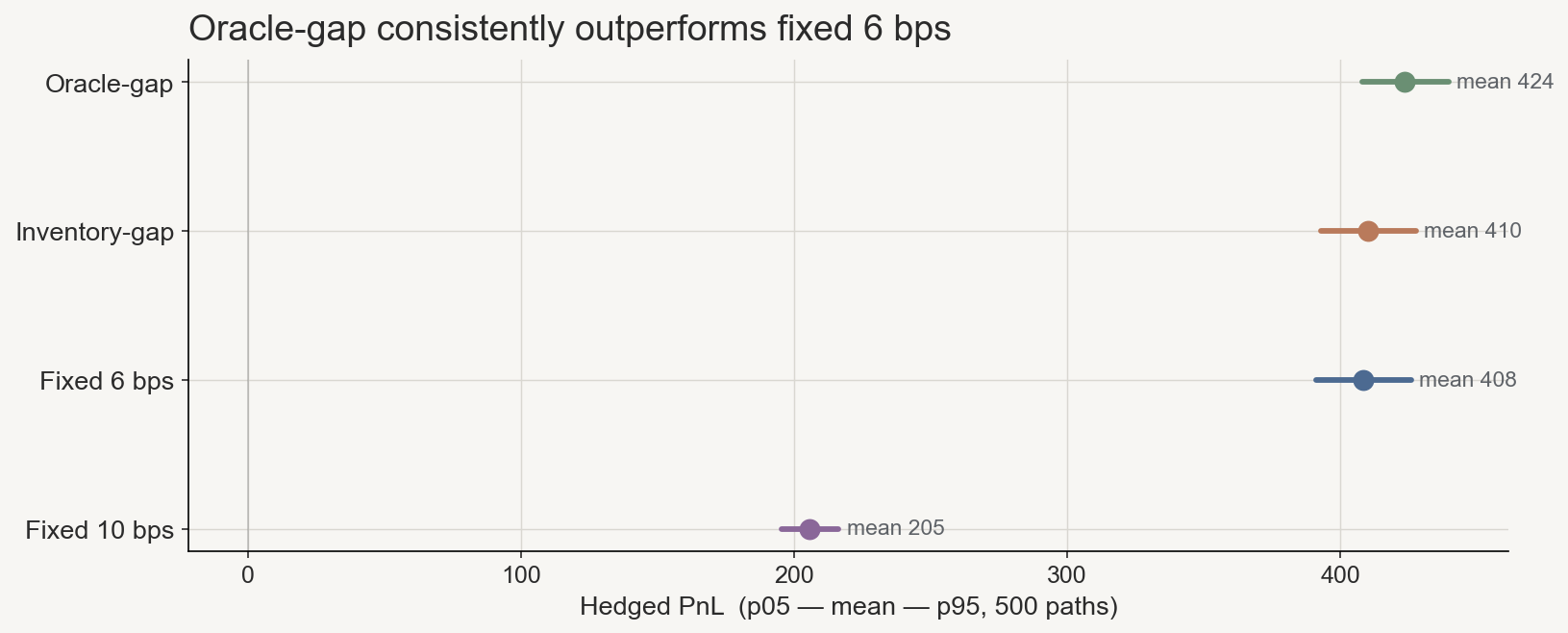
Each policy runs against the same price path and the same demand draws. The market did not get easier or harder for one policy. Statistically, Fig. 3 asks how much PnL changed when only the fee rule changed.
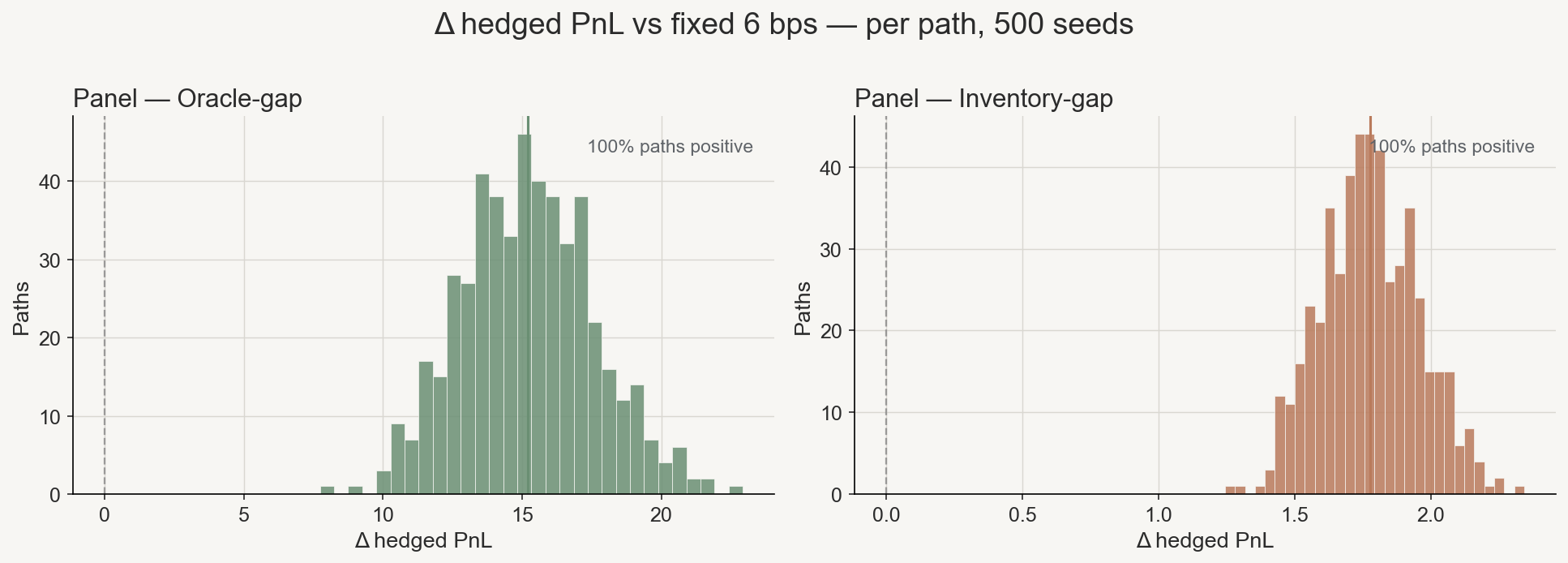
Inventory-gap also beat fixed 6 bps on every path, but mean gain was only +1.8—roughly one-eighth of oracle-gap’s advantage.
Inventory skew collapses into oracle gap
Inventory skew is not a new signal here. In a CPMM, both fields are monotone functions of the same quantity—deviation between AMM and CEX price:
let oracle_gap_bps  = (P_amm − P_cex) / P_cex × 10 000;
let inventory_skew  = (P_amm − P_cex) / (P_amm + P_cex);
When arb keeps the pool near the CEX price, P_amm ≈ P_cex and the skew denominator is approximately 2 × P_cex:
inventory_skew ≈ oracle_gap_bps / 20 000
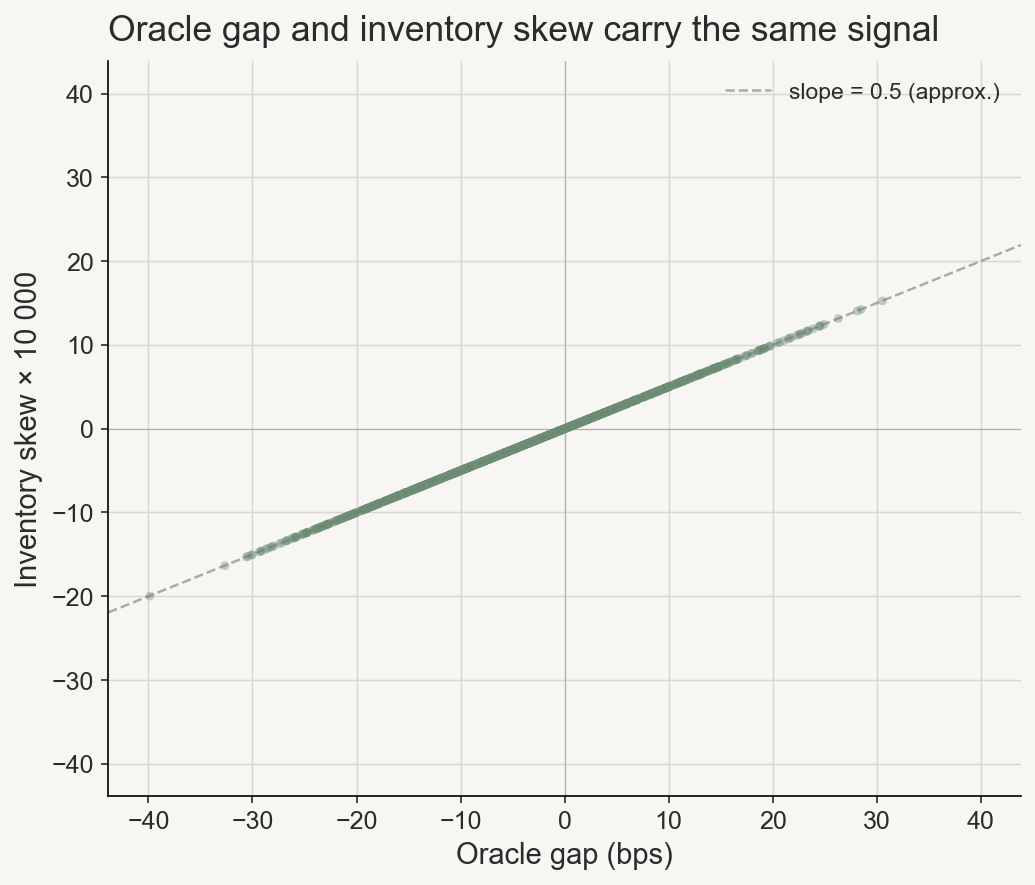
InventoryGapFeePolicy applies the same signal at lower gain—the step-level audit in the repo shows why. The +1.8 mean gain is amplitude, not a different signal.
This is specific to constant-product pools where arb continuously aligns pool price with the external reference. In pegged-pool designs, reserve imbalance can move while marginal price stays near peg, so inventory can carry information not captured by current oracle gap. Curve’s offpeg_fee_multiplier is aimed at that regime, not at CPMM-style rescaling.
What a hook should test next
If the feature is reserve-derived in CPMM, assume redundancy until shown otherwise. Current oracle gap is the primitive; inventory skew, reserve ratio, and pool price are functions of it. Adding them does not expand the information set. It rescales the response.
The next candidate is not another reserve-derived field. It is path-derived or external:
- Realized volatility: not recoverable from instantaneous CPMM state
- Order-flow imbalance: directional pressure within a block, visible before the swap executes
- Oracle latency: time since last reliable external update
- Toxic-flow proxy: share of recent volume from arb vs fundamental demand
These break collinearity because the invariant does not encode them. The test: does the feature add information beyond current oracle gap under the same path and demand assumptions?
Closing
Part II ran two settings: a seeded path where fees beat LVR, and a deterministic shock where LP-vs-hold stayed negative. The policy layer matters here: oracle-gap dynamic fees beat fixed 6 bps on every sampled path, while inventory-gap adds only a small lift because the two signals are nearly collinear.
That does not prove dynamic fees rescue LP economics in production. The run uses illustrative parameters (σ = 4%, μ = 0, 100 Y fundamental demand per step, CEX fee = 10 bps). The gain still depends on multiplier, demand, and volatility regime, even if the signal relationship is structurally redundant under the CPMM invariant.
Production should be stricter than simulation. This reduced-form world has no gas auction, block latency, queue dynamics, or LP repositioning cost. A hook that freely explores fee settings with LP capital can become statistical gambling once those frictions enter. The safer version starts from a champion rule, deviates only when edge clears cost and uncertainty, and can abstain.
Under CPMM, most fee innovation is control law, not information. The next test is strict: add a path-derived feature (realized volatility or order-flow proxy), check orthogonality to oracle gap on the same paths, then keep it only if paired PnL improves at matched risk.
Appendix: source
- Part I: The token appeared twice. The AMM market formed once.
- Part II: Before MEV, I Built a Rust AMM Lab to Measure Pool State.
- Part III: Hyperliquid Shows What a Market Looks Like Without an AMM Pool.
- GitHub Repo: amm-lab, Campbell simulation and dynamic-fee policy runs
- Campbell: Campbell, S., Bergault, P., Milionis, J., and Nutz, M. (2025). arXiv:2508.08152.
- Baggiani: Baggiani, L., Herdegen, M., and Sánchez-Betancourt, L. (2025). arXiv:2506.02869.