How I Turned AMM Logs Into a Causal Pipeline
The previous post reported the headline: no large short-run liquidity exit after UNIfication. This is the methods companion—how that reading was earned by freezing the empirical object before inference.
UNIfication moved liquidity provider (LP) take-rate while trader-facing swap fees stayed fixed. Posted swap-fee tiers cᵢ on each pool did not change; what changed was the share LPs retain per unit of liquidity supplied.
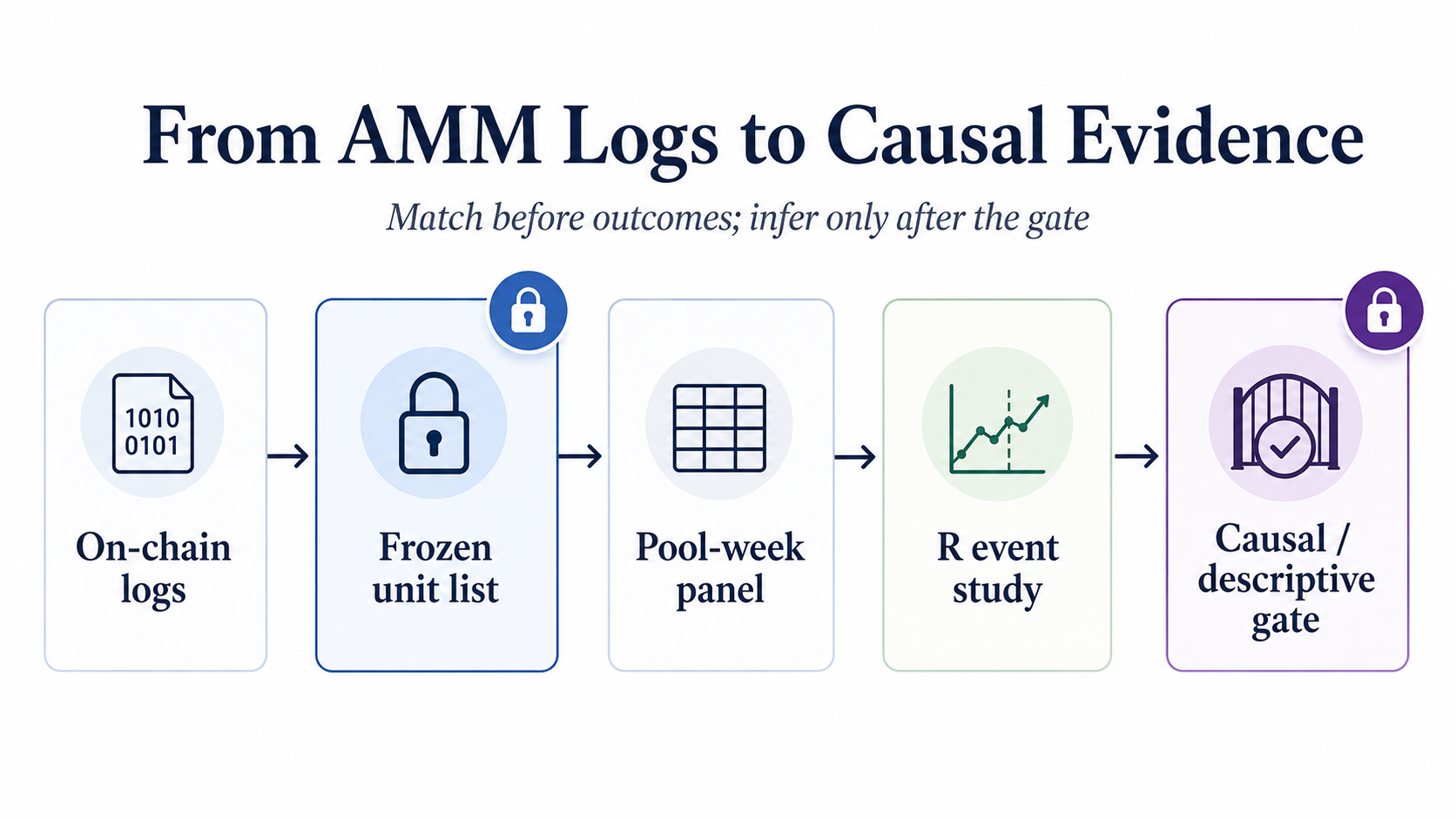
A governance shock is still not a research design. Before any post-period outcome could be interpreted, the pipeline had to reconstruct treatment and event time from logs, freeze a matched unit list blind to post-activation liquidity, rebuild outcomes only for those units, and run every outcome through the same causal gate. The paper and Rust implementation live in egpivo/amm-lab; the object that matters is the frozen panel—typed, hashed, and match-locked before R reads it.
Difference-in-differences (DiD) was the easy step. The discipline was freezing the design before any post-period coefficient could steer it.
Freeze the empirical object
The first failure mode is leakage: letting post-period outcomes influence who enters the sample, who counts as control, or what the counterfactual is. The Rust data layer closes that off in a fixed order, most critically in matching, which runs on pre-period inputs only and never sees post-period liquidity.
An early draft still mixed the steps: matching on pre-period fee revenue, then sanity-checking balance with post-period active liquidity—the standardized mean difference (SMD) looked better than it should have. That was already leakage; the fix was to hard-separate matching from reconstruction and hash panel_units.json before the outcome pull.
Treatment and event time from logs. SetFeeProtocol events define activation indicator Dᵢ, protocol share κᵢ (1/4 on 1 basis point (bp) and 5 bp tiers; 1/6 on 30 bp and 100 bp), and activation week t₀ᵢ from the event block timestamp—not the governance calendar date. Fork pools are excluded from the primary control reservoir.
What enters the matcher. Each pool becomes a Unit: pool id, treated flag, selection variable s (log pre-period realized fee revenue, not volume), fee tier, pair class, and a low_exposure flag from the spillover map (same unordered pair as a treated pool → spillover; one shared major token → exposed; primary controls require exposure ≤ 0.25). Reservoir pools must also be census-age, fee-revenue-positive, USD-numeraire-covered, and on the canonical Uniswap v3 factory.
| Step | Module | Output | Purpose |
|---|---|---|---|
| 1 | matching.rs |
matched_pairs.json |
caliper match output |
| 2 | design metadata | panel_units.json |
unit roles frozen here |
| 3 | panel.rs |
PoolWeek schema |
typed row contract |
| 4 | reconstruct.rs |
panel_weekly_rust.csv |
pool-week outcomes |
| 5 | adapter.rs |
role ↔ match check | Rust/R consistency check |
| 6 | artifact manifest | SHA256 per file | integrity lock |
How we wrote the match
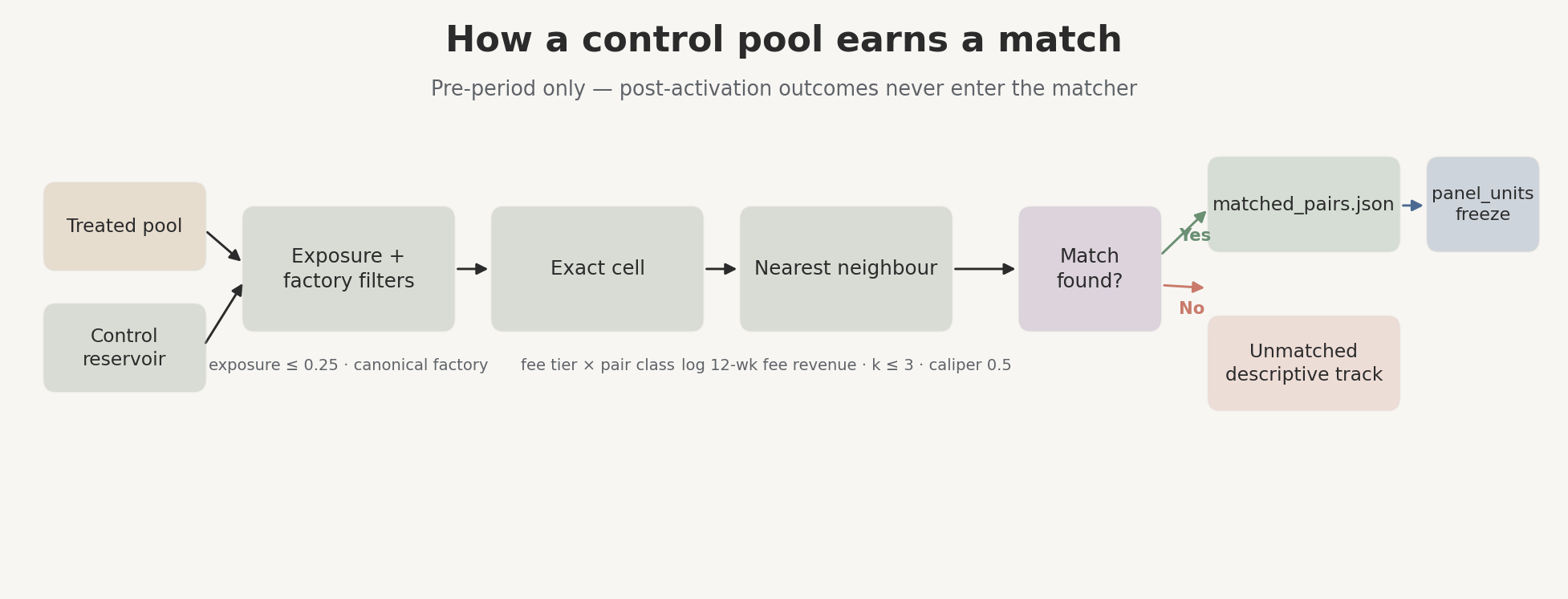
The core function is nn_caliper_match in src/causal/matching.rs. It encodes the frozen primary rule: exact strata on (fee tier, pair class), nearest-neighbour on s, caliper 0.5 log-points, k ≤ 3, with replacement. No outcome field exists on Unit—the matcher cannot leak post-period information because it has no access to it.
pub fn nn_caliper_match(units: &[Unit], caliper: f64, k: usize) -> MatchResult {
    let controls: Vec<&Unit> = units
        .iter()
        .filter(|u| !u.treated && u.low_exposure)
        .collect();

    for t in units.iter().filter(|u| u.treated) {
        let mut cand: Vec<(f64, &&Unit)> = controls
            .iter()
            .filter(|c| c.tier == t.tier && c.pair_class == t.pair_class)
            .map(|c| ((t.s - c.s).abs(), c))
            .filter(|(d, _)| *d <= caliper)
            .collect();
        cand.sort_by(|a, b| a.0.partial_cmp(&b.0).unwrap());
        // take up to k controls; unmatched if caliper empty
    }
}
Three design choices are easy to get wrong and are explicit in the return type:
- Strata are hard filters, not regression controls. A control in the wrong tier or pair class never enters
cand, even if it is close on fee revenue. - Unmatched treated pools are first-class output (
unmatched_treated), not dropped silently. They carry no counterfactual and do not enter the primary average treatment effect on the treated (ATT). - With-replacement multiplicity is tracked in
control_freq: HashMap<String, usize>—how many treated units each control was matched to. A plain set of used controls would drop this; the estimator would then under-weight controls that serve multiple treated pools.
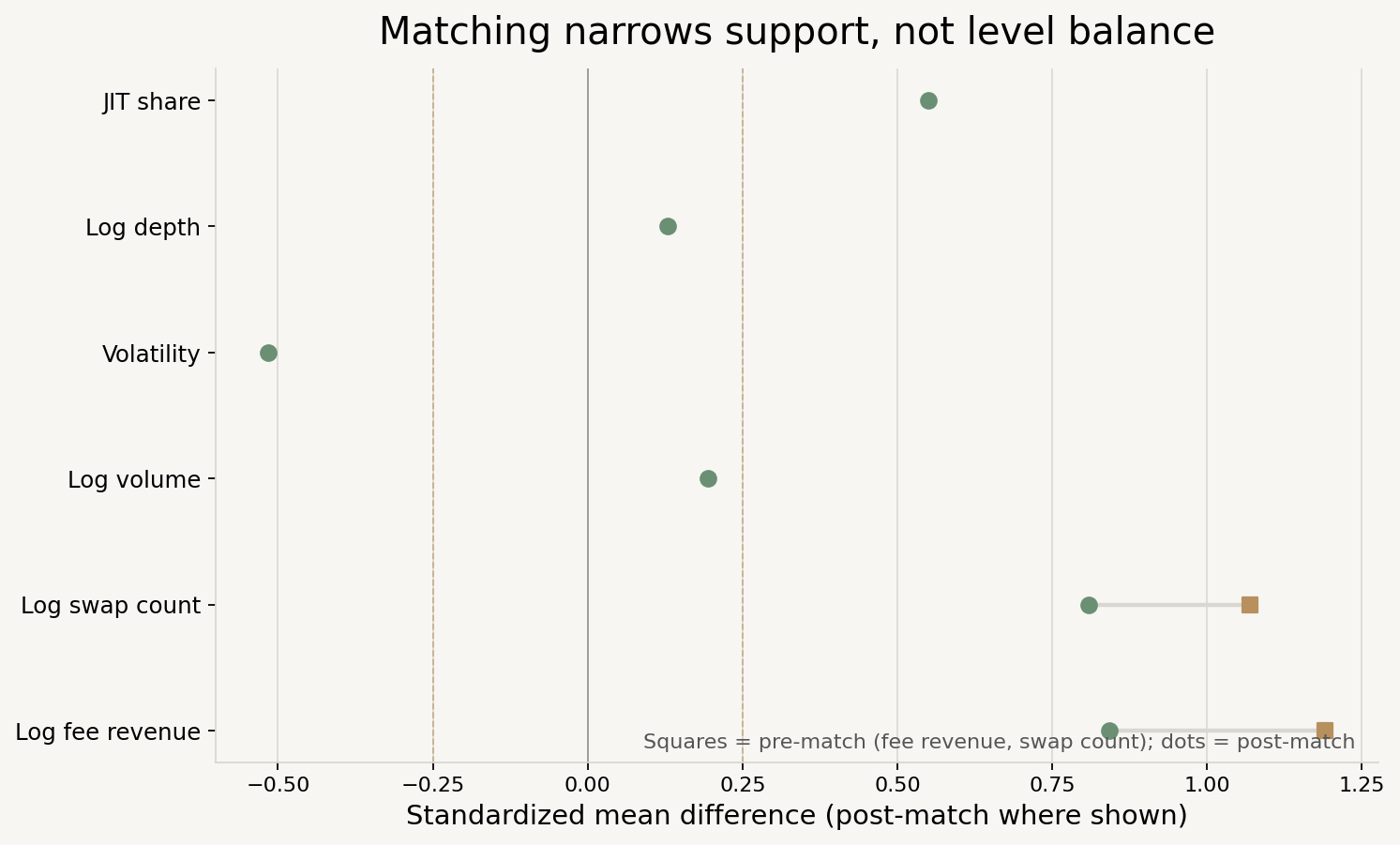
The module ships unit tests that pin the contract: caliper and strata respected, unmatched when no control is in-band, wrong-tier and wrong-class controls rejected, exposed controls excluded. smd on the same scale reports balance diagnostics (fee-revenue SMD 1.19 → 0.84 after match—support improves, covariate balance does not).
786 of 868 treated-main pools find a match; 314 distinct controls are assigned; roles freeze in panel_units.json before the post-period pull. The pre-registered ±8-week event window then trims the primary sample to 779 treated pools and 303 controls—long enough for a weekly liquidity response to show up, short enough to avoid drifting into unrelated regime shifts. ±6 felt tight; ±12 opened more slow-confound risk. Not uniquely correct, but the least-bad compromise on those two margins.
Panel rebuild
After the unit list freezes, reconstruct.rs replays normalized Swap / Mint / Burn / Collect events per pool: tick-book seed → ordered replay → weekly time-weighted active liquidity, depth at ±1/2/5%, LP lifecycle fields. Each row is a typed PoolWeek with an explicit UnitRole—matched_treated, matched_control, unmatched_treated, crossvenue_fork—so primary controls are never defined as “treated == 0.”
adapter.rs checks roles against the match: every MatchedTreated / MatchedControl label must agree with the MatchResult, and no matched unit may hide under a fork or unmatched role; panel::compare() then row-checks the reconstructed CSV against the golden artifact. Rust doesn’t decide causal labels—its job is to make the frozen object typed, auditable, and drift-resistant before R reads it.
Why Rust for the panel layer. Not the match logic, which is a few dozen lines either way—the bottleneck is data handling at node-RPC scale: tens of millions of log rows from Ethereum JSON-RPC, a stateful tick book, i128 liquidity deltas, and event ordering that has to survive a re-run six months later. Rust buys typed schemas, exact integer paths where Python would round, and parity tests that fail loudly when a reconstructed column drifts.
What the frozen panel hands to inference
Data engineering ends when the pool-week table is frozen. Causal inference begins when R reads it. Each row is one (pool, week)—not a dashboard export, but a typed schema:
| Group | Field | Meaning |
|---|---|---|
| identity (time-invariant, absorbed by the pool FE) | pool |
address |
token_pair |
unordered pair id → cluster_key |
|
fee_tier |
u32 | |
| design (frozen before the post-period pull) | unit_role |
matched_treated | matched_control | unmatched_treated | crossvenue_fork |
match_weight w |
f64, from MatchResult.control_freq — 1 for treated, multiplicity for controls |
|
| event_time | week |
"YYYY-WW", calendar week on the frozen grid |
t0_week |
"YYYY-WW", SetFeeProtocol activation week (treated only) |
|
rel_week k |
i32, week_index − t0_index; reference k = −1 |
|
| outcomes (dependent variables under the causal gate) | twl_active_liquidity |
time-weighted active liquidity |
depth_1pct, depth_2pct, depth_5pct |
depth bands | |
lp_entry_count, lp_exit_count, unique_lp_count |
LP participation | |
jit_share_same_block, position_duration_days |
JIT = just-in-time liquidity share; position duration | |
vol0, vol1, lp_fee_income_native1 |
token-0 / token-1 volume; LP fee income | |
| inference_keys | pool_id |
→ pool fixed effect |
week_id |
→ week fixed effect | |
cluster_key |
→ token-pair cluster-robust standard errors (SE) |
Volume and native LP fee income sit in outcomes. They are not pushed into the main specification as controls—that would absorb the response the design is trying to measure.
Run the gate in R
The second failure mode is interpretation drift: treating every coefficient from the same event-study regression as causal. Reported inference comes from R. Rust event_study.rs reproduces point estimates as a parity check; it does not assign labels.
Once the panel is frozen, the questions are econometric: absorbed fixed effects (FE) on 17k pool-weeks, token-pair clustering, a joint pre-trend Wald test, wild cluster bootstrap (fwildclusterboot), and Honest-DiD sensitivity bounds (HonestDiD)—maintained estimators for the failure modes a DeFi panel actually hits, run via fixest alongside the Rust panel in amm-lab.
Matched overlap, not all activated pools. Identification rests on dynamic parallel trends in untreated increments, not post-match covariate equality; unmatched high-revenue pools are reported separately from the primary ATT.
R reads control_freq from the match as frequency weights on controls; the ±8-week window leaves 17,598 pool-weeks across 1,013 token-pair clusters.
Event-study DiD:
feols(
  yt ~ i(rel, treated, ref = "-1") | pool + week,
  data = d, weights = ~w, cluster = ~cluster_key
)
Pool fixed effects absorb time-invariant pool traits (pair, tier, posted cᵢ); week fixed effects absorb market-wide shocks. Token-pair clustering respects correlated shocks across pools sharing a pair, and frequency weights preserve with-replacement matching—the same control_freq object tracked in Rust.
Outcome routing. The gate does not search for significance. It decides whether a coefficient path is allowed to receive a causal label.
The same gate rule runs for every outcome:
| Gate step | Rule |
|---|---|
joint_pre_trend |
Wald test on all pre-period leads; reject at pre-specified α → pre-trend fail → descriptive |
post_path |
β_k confidence intervals (CIs) include zero throughout the post window |
honest_did |
relative-magnitude bounds on outcomes that pass pre-trends |
placebo_dates |
pre-period fake activations |
caliper_robustness |
0.25 / 0.5 / 1.0 log-point support check |
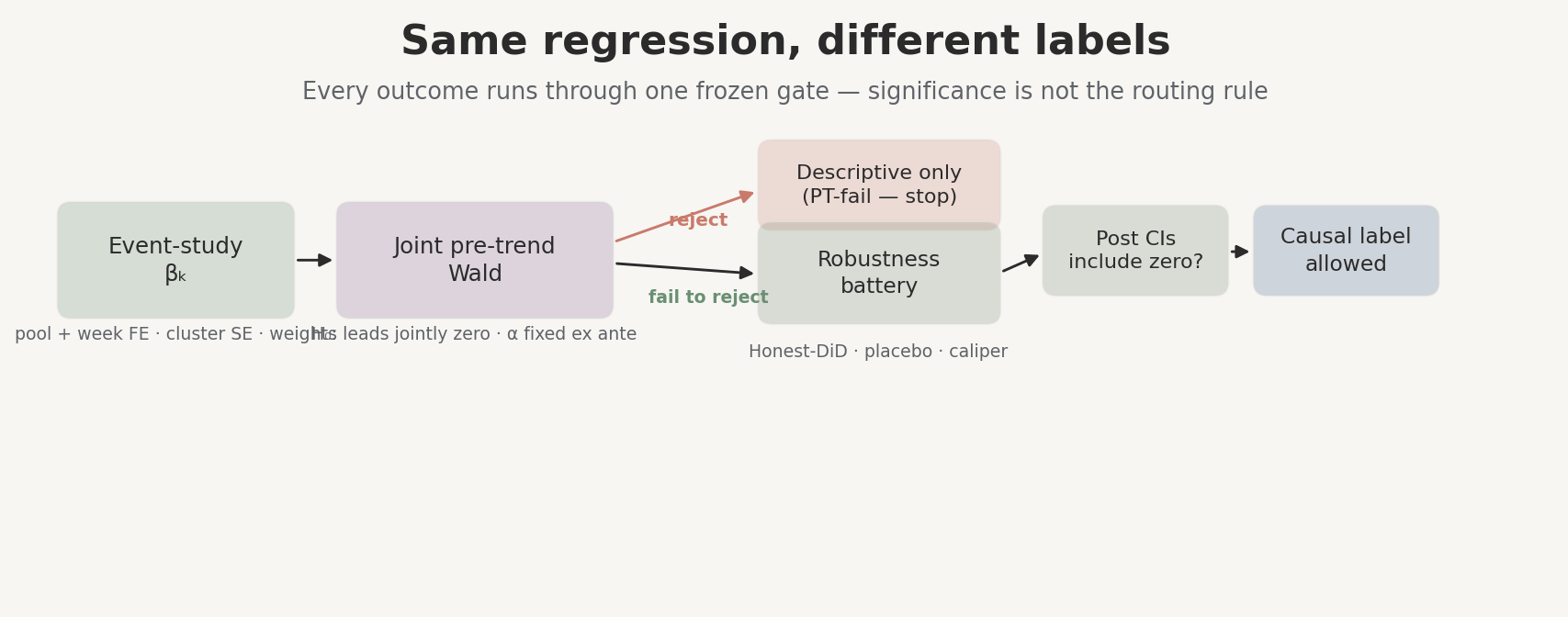
analysis_es.R: pre-trend failure routes an outcome to descriptive regardless of post-period significance. Outcome-by-outcome results are in the previous post's gate map.
Active liquidity passes (joint lead test p = 0.91). Depth ±2% passes (p = 0.25). The sensitivity checks do not turn these paths into precise effects; the interpretation remains an identified non-detection (no large effect found at this resolution). The main event-study paths for liquidity and depth are in the previous post—not repeated here.
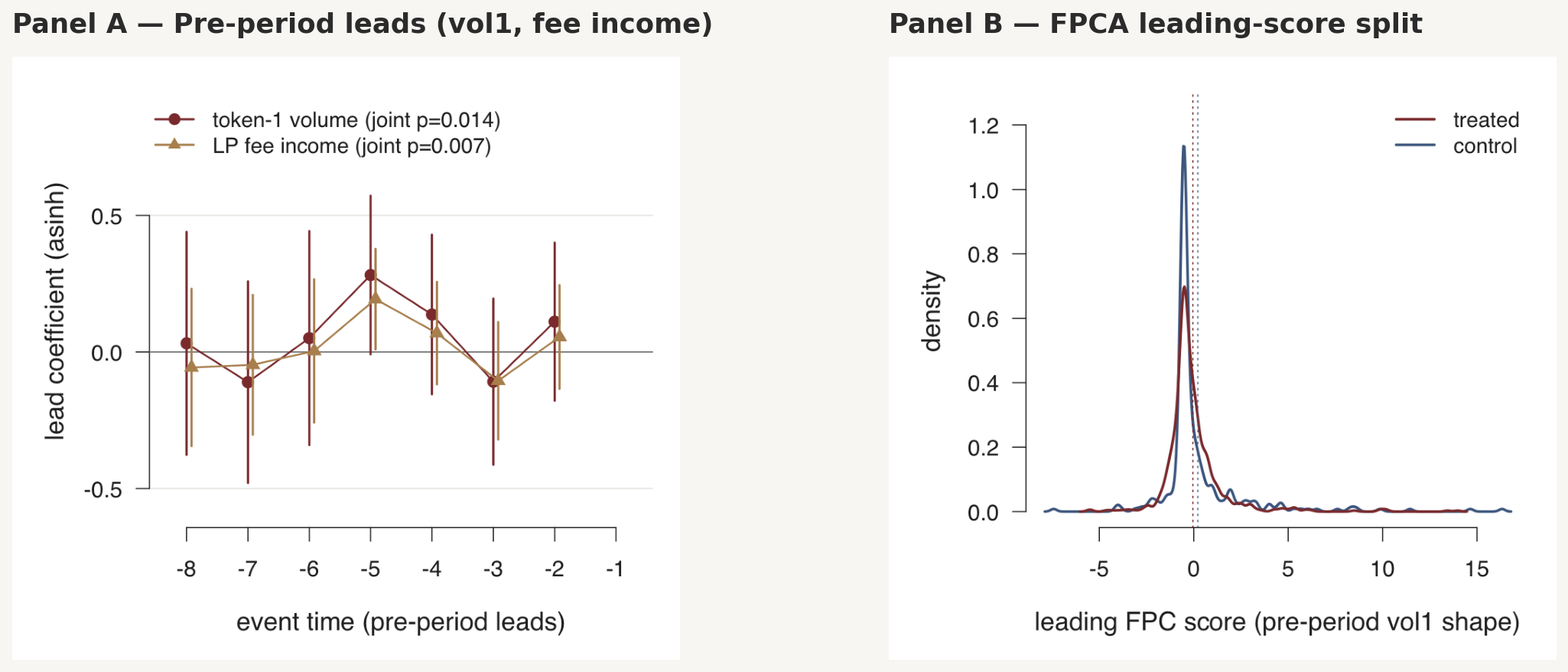
Token-1 volume (joint lead test p = 0.014) and native LP fee income (p = 0.007) fail the pre-trend gate: post-period coefficients aren’t sharply different from zero, but under the frozen rule they stay descriptive, not causal.
When parallel trends fail on flow outcomes
Pre-period leads drift before activation on both flow outcomes (Fig. 4, Panel A)—a parallel-trends failure on the fee-revenue selection margin at this panel’s weekly resolution.
fpca_diagnostic.R (fdapace) runs a functional principal component analysis (FPCA) on centered pre-period token-1 volume trajectories: treated and matched controls separate on the leading score (permutation p = 0; Panel B). An auxiliary factor-model (fect) route failed validation. Flow and fee income stay descriptive: the shape split is documented, not rescued.
The liquidity nulls survive a gate that flow outcomes do not. The panel is pool-week, so intraweek routing and just-in-time (JIT) liquidity collapse into weekly sums—a resolution limit if flow timing matters, not proof that flow didn’t move.
What the stack refuses to identify
Public logs support a reduced-form read on K_L—the short-run liquidity-supply response when LP take-rate ρ moves and posted swap fee cᵢ stays fixed. They do not identify dynamic-fee protection, since cᵢ never varies within a pool here, and trader type, router choice sets, and the arbitrage-versus-flow split in fee income all stay latent. Where parallel trends fail and auxiliary factor routes don’t recover identification, a descriptive read may reflect limited temporal resolution as much as a true zero effect.
If I rebuilt this panel in a year, temporal resolution would move before the estimator.
Closing
The fee switch gave the shock; the frozen panel defined the empirical object; the matched design supplied the counterfactual; the R gate decided which outcomes could carry a causal label. The previous post reports what passed that bar on liquidity—this one is the stack underneath it.
The next build isn’t a fancier estimator. It’s a higher-resolution panel if flow timing matters, or a cross-venue read if reallocation happens outside the matched pool set.
Appendix: sources and reproducibility
Paper and code: Wang, Wen-Ting (2026). Causal Effects of Protocol-Fee Changes on Liquidity Provision in Automated Market Makers. arXiv:2607.08525 — code and frozen panel, plus diagnostics fpca_diagnostic.R and fect_vol1.R, at egpivo/amm-lab.
Methods references: event-study DiD (Sun and Abraham, 2021, doi:10.1093/restud/rdab034; Roth et al., 2023, doi:10.1093/restud/rdad016); Honest-DiD (Rambachan and Roth, 2023, doi:10.1093/restud/rdad018, R package HonestDiD); wild cluster bootstrap (Roodman et al., 2019, doi:10.1093/ectj/utz015, R package fwildclusterboot); interference/exposure (Aronow and Samii, 2017, doi:10.1093/biomet/asx046); asinh transform (Bellemare and Wichman, 2020, doi:10.1017/psrm.2019.65). Event studies run on fixest; pre-period shape diagnostics on fdapace.
Series: Part II · Part V (results this post supports) · this post (methods companion)